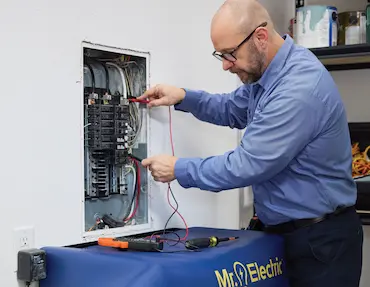
Tampa Bay homeowners lose thousands of dollars in appliances, HVAC systems, and electronics to power surges every storm season and most of those losses are preventable. A whole-home surge protector installed at your electrical panel typically costs $700 to $1,200 and protects every circuit in the house simultaneously, from your air conditioner and refrigerator to your EV charger and smart-home devices. A standard power strip cannot stop a Florida lightning surge; a panel-mounted surge protective device (SPD) can, and under the 2020 NEC (Article 230.67) it is now required on new and replacement electrical services.
Learn moreMr. Electric of Tampa Bay Blog
Shared Resources for Your Home Needs
National Electrical Safety Month: Your Guide to Checking Electrical Hazards in Your Home
May is National Electrical Safety Month, making it the ideal time to check the systems that homeowners rely on every day. Electrical hazards often develop quietly through overloaded circuits, aging panels, or outdated outlets until they become costly or dangerous problems.
All Blogs
Mr. Electric of Tampa Bay provides professional holiday lighting installation across Hillsborough and Pinellas counties for the full season Halloween, Thanksgiving, Christmas, and New Year’s. As both a licensed electrical contractor (EC13015799) and a CLIPA-certified holiday lighting installer, we handle the complete service: custom design, professional-grade lighting, safe installation, in-season maintenance, and full removal after the holidays. Unlike seasonal-only outdoor lighting companies, we bring licensed electrical expertise to every install proper power sources, GFCI protection, timers, and circuits that will not overload backed by 1,000+ reviews and the Neighborly Done Right Promise.
Learn moreSt. Petersburg is one of Florida’s great historic cities, and its neighborhoods show it. Brick streets, 1920s bungalows, Mediterranean Revival estates, mid-century ranches, and waterfront homes along the Tampa bayfront give the city a character that newer inland communities cannot match. But that same history means St. Petersburg’s housing stock carries some of the oldest electrical infrastructure in the Tampa Bay area and the electrical needs of a 1925 Old Northeast bungalow are nothing like those of a renovated Snell Isle waterfront home or a 1950s Pinellas Point ranch.
Learn moreA home electrical safety inspection in Tampa is not a generic checklist. What a licensed electrician finds depends on when your neighborhood was built: pre-1950 bungalows in Seminole Heights and Hyde Park often have knob-and-tube wiring and 60-amp service; mid-century homes in Carrollwood and Palma Ceia commonly have aluminum branch-circuit wiring from 1965–1973; 1985–2005 subdivisions in Westchase and New Tampa typically lack surge and AFCI protection; and waterfront homes on Davis Islands and Bayshore face salt-air corrosion and dock-wiring compliance. A licensed inspection opens the panel, tests every protection device, and produces a written report with a repair quote typically $500–$1,000 in Tampa Bay.
Learn moreMr. Electric of Tampa Bay serves South Tampa homeowners across the full peninsula, from the brick streets of Hyde Park to the deep-water canals of Culbreath Isles. But South Tampa is not one neighborhood with one type of home. It is ten distinct communities, each with its own architectural era, construction style, and set of electrical challenges that come with the territory. A 1920s bungalow in Hyde Park carries different electrical risks than a 1960s ranch in Virginia Park or a new-construction waterfront home in Davis Islands. Knowing the nuances of your Tampa home build matters when a breaker trips, a panel needs upgrading, or a homeowner wants to add an EV charger without overloading a 100-amp service that was never designed for it.
Learn moreIf your circuit breaker keeps tripping, the most likely cause is that your electrical panel does not have enough capacity for the total power your household draws. Homes in Hyde Park, Palma Ceia, Davis Islands, Carrollwood, and Old Northeast were built with 100-amp or 150-amp panels sized for the electrical loads of the 1970s, 1980s, and 1990s. Those loads no longer reflect how Tampa Bay families live. EV chargers, dual-zone HVAC systems, pool equipment, home offices, induction cooktops, tankless water heaters, and smart home devices have collectively pushed residential power demands well beyond what these original panels were engineered to handle.
Learn more