
Licensed Electrician in Charlotte, NC
When breakers trip, lights flicker, or you need an upgrade, you need a licensed electrician who knows Charlotte homes. You need an electrician Charlotte residents trust. Mr. Electric® of South Charlotte is locally owned and operated, serving Charlotte and south Mecklenburg County since 1994. We handle panel upgrades, rewiring, EV charger installation, and emergency repairs. Call us to schedule service with our Charlotte electricians.

Book Online
A representative from our office will get back to you shortly to schedule service.
Due to a system error, we did not get your request. Please call us for immediate assistance.
We don't currently provide service to this ZIP/Postal code.
Yes! You can email me service reminders and other messages.
Mr. Electric, a Neighbourly Company on its own behalf and on behalf of and its affiliates and franchisees requests your consent to send promotional and other electronic messages to you concerning products and services they believe are of interest to you. By checking this box, you agree to receive these messages. You can unsubscribe at any time.
Text opt-in does not apply for Canadian residents.

Customer Reviews
View All Testimonials
The Neighborly Done Right Promise® delivered by Mr. Electric®, a proud Neighborly company.
Easy Online BookingResidential and Commercial Electrical Services by a Team of Trusted Electricians in Charlotte
When you schedule service with our Charlotte electrician team, we arrive within your scheduled two-hour window wearing shoe covers and carrying professional equipment. Our electrician will perform an electrical safety inspection, spending 20-30 minutes checking out your panel’s condition, testing GFCI outlets with a three-light tester to verify proper wiring, and looking for code violations like missing AFCI protection in bedrooms. We look for loose wire connections, signs of arcing, and inadequate grounding to your home's grounding electrode system. We use a thermal imaging camera to detect hot spots in panels and outlets before they become visible problems. We explain findings and provide recommendations ranked by safety priority. We handle permits when required by the City of Charlotte or Mecklenburg County.
-
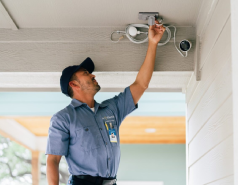
Installations
Mr. Electric installs top-of-the-line electrical equipment to help you save on energy costs.Learn more Installations
-

Lighting
Our experts can handle any lighting fixture for a single-family home, apartment, condo, or business.Learn more Lighting
-
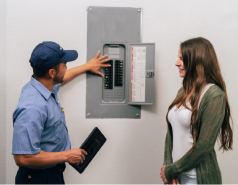
Electrical Safety
Let our expert electricians keep your home or business above building code standards.Learn more Electrical Safety
-
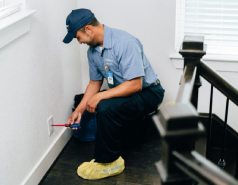
Repairs
Your courteous Mr. Electric electrician will arrive and finish on time, barring unforeseen issues.Learn more Repairs
Let us know how we can help you today.
Why Homeowners in Charlotte Choose Our Electrical Services
-
We are licensed by the North Carolina Board of Examiners of Electrical Contractors. Our team completes background checks, carries insurance and bonding, and receives ongoing training in the latest National Electrical Code updates. When we arrive at your Charlotte home, you get a uniformed professional in a marked vehicle with the tools and parts to complete most jobs in one visit. We start with a complimentary electrical safety inspection to check your panel for corrosion caused by Charlotte's 70% average humidity. We look for signs of overheating from undersized breakers, outdated Federal Pacific or Zinsco panels with documented failure rates, and capacity issues when your 100-amp service tries to handle modern loads. Our inspection catches problems before they become $5,000+ repair emergencies.
-
Mr. Electric of South Charlotte is locally owned and operated. We live here. We work here. We know Charlotte's housing stock inside and out. Homes in Dilworth and Myers Park were built between 1915 and 1955, when 60-amp service was considered adequate. Today, those same homes run central air conditioning, pulling 20 amps; electric ranges, drawing 50 amps; and modern appliances, adding another 40 amps of constant load. Aluminum wiring installed during the 1965-1973 copper shortage is found in thousands of Charlotte homes, creating connection points 55 times more likely to reach fire-hazard conditions, according to the U.S. Consumer Product Safety Commission.
Newer neighborhoods like Ballantyne and Stonecrest have 200-amp service but require dedicated circuits when adding Level 2 EV chargers that draw 40-50 amps. Summer temperatures reaching 90-95 degrees put HVAC systems under continuous load. Frequent afternoon thunderstorms make whole-house surge protection essential. We understand these local challenges because we encounter them daily. As part of the Neighborly network established in 1994, we combine local accountability with national brand standards. Every job is backed by the Neighborly Done Right Promise®.
-
Whether it's a simple repair or a custom installation, you receive a written quote that includes labor, materials, permit fees, and a timeline. You approve the price before we start work. If we find additional issues, like corroded neutral bars or damaged bus bars, while working, we stop and discuss your options. You decide whether to proceed with additional repairs. We complete work, test all circuits, verify proper voltage at outlets, restore power, and walk you through what we did. We clean up after we finish, removing all debris and packaging. Your satisfaction is ensured.
307 W Tremont Ave Suite 200 Charlotte, NC 28203, United States
Mr. Electric of South Charlotte
Frequently Asked Questions About Our Electrical Services in Charlotte, NC
-
A complete panel upgrade in Charlotte takes approximately 6-8 hours of work after permits are approved, with a full timeline of 10-14 days from start to finish. This includes:
- Day 1: We apply for an electrical permit through the City of Charlotte or Mecklenburg County if you're outside of city limits. Permit review and approval take 3 to 7 business days.
- Day 8-10: We coordinate with Duke Energy to schedule a temporary disconnect, which requires 2-3 business days' notice.
- Installation day: Your power will be off for 4 to 6 hours while we work. We replace the meter base, disconnect the old panel, mount and wire the new 200-amp panel, connect all existing circuits to properly sized breakers, install required AFCI breakers for bedroom circuits per 2020 National Electrical Code, label every circuit clearly, install a main bonding jumper, verify grounding electrode connections, and test the complete system before restoring power. Duke Energy reconnects your meter.
- Final inspection: A city or county electrical inspector visits within 2 to 5 business days to verify code compliance, proper grounding, correct breaker sizing, and proper panel installation. Once inspection passes, your upgrade is complete and documented in public records.
-
You need a 200-amp panel upgrade if your Charlotte home meets any of these conditions:
- Your current panel shows 100 amps or less on the main breaker
- You plan to install a Level 2 EV charger requiring a dedicated 40-50 amp circuit
- Circuit breakers trip two or more times monthly when running normal loads
- You are adding central air conditioning, requiring a 20-30 amp dedicated circuit
- You are finishing a basement or building an addition, adding 10+ circuits
- You have a hot tub drawing 50 amps or pool equipment pulling 20-30 amps
- Your home was built before 1985 and never had an electrical service upgrade
A licensed electrician performs a load calculation in accordance with NEC Article 220 to determine your actual needs. We add up all fixed appliances at nameplate rating, general lighting, and receptacles at 3 watts per square foot, and apply demand factors to determine minimum service size. In Charlotte's climate, HVAC systems run 8-10 hours daily in summer, pulling 15-20 amps continuously. Adding a 40-amp EV charger to a fully loaded 100-amp panel creates 140 amps of potential demand, overloading the service entrance and creating fire risk at the main breaker and meter base connections. Upgrading to a 200-amp service provides 80-100 amps of available capacity after accounting for existing loads, supporting modern lifestyle needs and future electrical additions without safety concerns.
-
EV charger installation in Charlotte includes seven essential steps. First, we need to assess your electrical panel to calculate available capacity by subtracting the existing circuit loads from your main breaker size. Following the assessment, we'll be able to verify if your panel has space for a new 40- or 50-amp double-pole breaker, depending on your charger model. A permit will be required for the installation. We'll then run a dedicated 240-volt circuit from the panel to the charger location, using 6 AWG copper wire for 50-amp circuits or 8 AWG for 40-amp circuits, installed in conduit for garage installations or through attic spaces for outdoor charger locations.
Next, we install the appropriately sized breaker with proper torque specifications. We'll mount the charging unit on a wall or post at the manufacturer's specified height, typically 48 inches from the center of the unit. Once everything is installed, we schedule an inspection. After passing inspection, we test the charger under full load to verify proper voltage and correct amperage delivery, and to ensure safe operation.
Most Level 2 EV chargers draw 7.6 to 11.5 kilowatts at 240 volts. A 40-amp charger delivers up to 9.6 kW. A 50-amp charger delivers up to 11.5 kW. Higher amperage means faster charging. A 50-amp charger adds approximately 37 miles of range per hour of charging compared to 30 miles per hour with a 40-amp charger. If your panel lacks available capacity, we recommend completing a 200-amp panel upgrade before installing the charger. Installation typically takes 4 to 6 hours for straightforward jobs with panel space and clear wiring paths. We provide detailed upfront pricing after assessing your specific situation and charger model requirements.
-
North Carolina General Statute 87-43 requires that a licensed electrical contractor perform all electrical installations, alterations, and repairs except for work on your own property under limited circumstances. The North Carolina Board of Examiners of Electrical Contractors enforces this requirement and issues penalties for unlicensed work. Attempting electrical work without proper training and licensing puts you at immediate risk of 120-volt or 240-volt electrical shock, causing cardiac arrest, arc flash burns from short circuits reaching 35,000 degrees, and structure fires from overloaded circuits or improper connections.
DIY electrical work creates four major problems. First, unlicensed work violates North Carolina building codes and fails inspection. The work will need to be redone by a licensed contractor at double the original cost. Second, if a fire occurs and investigators find unlicensed electrical work, your homeowner's insurance claim will be denied, leaving you responsible for $100,000+ in damages. Third, improperly done work can create hazards that go unnoticed until a catastrophic failure occurs. Lastly, when selling your home, any unpermitted electrical work discovered during inspection can kill deals or require expensive corrections before closing.
A licensed electrician understands critical safety requirements, such as proper wire sizing, circuit protection requirements, and grounding and bonding requirements that protect you from shock hazards. They understand GFCI protection in wet locations, and AFCI protection in bedrooms. We know what work requires permits, how to pass inspections on the first visit, and how to meet the 2020 National Electrical Code adopted by North Carolina. Electrical mistakes cannot be fixed with online videos. They require professional correction and put your family at risk daily.
-
Ten warning signs indicate immediate electrical problems requiring professional repairs:
- Circuit breakers trip more than once a month, signaling overloaded circuits, deteriorated breakers, or short circuits
- Lights flicker when appliances start indicating inadequate circuit capacity, loose neutral connections, or problems at the utility connection
- Outlets or switches feel warm to the touch, showing dangerous heat buildup from loose connections, overloaded circuits, or improper wire sizing
- A burning smell near electrical components means overheated wire insulation requiring immediate power shutoff and an electrician call
- Sparks when plugging in devices indicate damaged outlets, reversed polarity, or ground faults
- Buzzing or crackling sounds from panels or outlets signal arcing connections, loose breakers, or failing components
- Discolored outlet covers or scorch marks near panels point to dangerous arcing or sustained overheating
- GFCI outlets that will not reset indicate ground faults, moisture infiltration, or failed GFCI devices requiring replacement
- Lights dim when the AC starts showing inadequate service capacity or high resistance connections
- Two-prong ungrounded outlets throughout your home mean that missing safety grounding was eliminated in the 1962 code updates
Three additional Charlotte-specific warning signs:
- Aluminum wiring in homes built 1965-1973 requires inspection when outlets feel warm
- Knob-and-tube wiring in homes built before 1950 needs replacement when insulation shows brittleness
- Panels in humid crawl spaces show accelerated corrosion requiring close monitoring.
Charlotte's average relative humidity of 70% accelerates corrosion at electrical connections, particularly in crawl spaces and outdoor panels. Annual inspections catch problems before they become emergencies, costing $2,000-$5,000 in emergency repairs plus property damage.
-
Charlotte neighborhoods built before the 1940s, like Dilworth, Myers Park, Elizabeth, and Plaza-Midwood, have homes with four recurring electrical problems. First, knob-and-tube wiring was standard from the 1880s through 1945. This wiring method uses separate hot and neutral wires running on ceramic insulators through wall cavities. Some common problems include no equipment grounding conductor, creating shock hazards; cloth insulation deteriorating after 70-100 years, exposing bare copper; inadequate capacity for modern loads; and incompatibility with modern insulation, causing dangerous overheating. Most insurance companies refuse coverage or charge 50-100% higher premiums for active knob-and-tube wiring.
Second, aluminum branch circuit wiring appears in Charlotte homes built 1965-1973. The U.S. Consumer Product Safety Commission conducted extensive research, published in CPSC Document 516, finding that homes with aluminum wiring manufactured before 1972 are 55 times more likely to have one or more connections reach fire-hazard conditions than copper-wired homes. Aluminum expands and contracts 30% more than copper with temperature changes, resulting in loosened connections at outlets, switches, and breakers. Oxidation forms at connection points, increasing electrical resistance, generating heat, and eventually causing fires.
Third, undersized electrical service appears in 80% of Charlotte homes built before 1980. A 60-amp service common in 1950s homes provides only 14,400 watts at 240 volts, barely adequate for central AC alone. A 100-amp service standard through 1985 provides 24,000 watts, and is insufficient for modern homes that need 35,000-48,000 watts.
Fourth, missing grounding and GFCI protection puts occupants at risk. Homes built before 1962 lack equipment grounding. Homes built before 1975 lack GFCI protection in bathrooms. Homes built before 1987 lack GFCI in kitchens and garages.
-
All of our electricians are licensed by the North Carolina Board of Examiners of Electrical Contractors established under North Carolina General Statute 87-39. North Carolina requires state-level licensing for all electrical contractors with three license classifications.
Ultimately, hiring a licensed electrician protects you legally, ensuring contractors meet minimum competency standards, guarantees proper insurance coverage if property damage or injuries occur, ensures work meets National Electrical Code and local amendments, and provides recourse through NCBEEC if work is deficient or contractors abandon jobs. Unlicensed electrical work voids homeowner's insurance coverage, fails to pass inspections, creates liability when selling your home, and puts occupants at daily risk from fire and shock hazards.
-
Most electrical work in Charlotte requires a permit issued by the City of Charlotte or Mecklenburg County, depending on your location within city limits or unincorporated county areas. The City of Charlotte requires permits for these specific projects:
- Electrical panel replacements or service upgrades from any amperage to a higher amperage
- New circuit installations, adding wiring to your electrical system
- Whole-house rewiring or room rewiring, replacing existing conductors
- Permanent lighting installations, including recessed lights, require new circuits
- Service entrance changes, including mast or underground service modifications
- Dedicated appliance circuits for ranges, dryers, water heaters, and HVAC equipment
- Electric vehicle charger installations requiring 240-volt dedicated circuits
- Electrical work in finished spaces requiring drywall removal
- Any work adding more than two circuits to existing panels
Permits are not required for simple repairs, including replacing a damaged outlet with an identical outlet, swapping a light fixture using existing wiring and junction box, replacing a switch, replacing a damaged breaker with an identical amperage breaker, or repairing damaged wire insulation. When we provide your quote, we specify whether work requires a permit and include permit costs. We handle permit applications online through the City of Charlotte's permit portal, pay permit fees ranging from $75 to $300 depending on project scope and valuation, upload required diagrams showing panel location, circuit routing, and equipment specifications, and receive permit approval within 3-7 business days.
Permitted work protects you in numerous ways. First, inspections verify that work meets the 2020 National Electrical Code adopted by North Carolina. Permit records document upgrades for future home sales. Insurance companies honor claims when permitted work is involved. Permitted work receives a certificate of occupancy when required. Permits provide legal protection if the work is deficient, allowing you to file complaints with building services and pursue actions with the contractor licensing board. Unpermitted electrical work discovered during home sales kills transactions, requires expensive corrections before closing, or reduces sale prices by $5,000-$15,000.
-
The electrical permit process in Charlotte follows eight steps and takes 10-14 days from application to final approval.
- Step 1: We apply online through the City of Charlotte's permit portal at charlottenc.gov or in person at Charlotte-Mecklenburg Government Center at 600 East Trade Street. Applications require the property address, the property owner's name, the contractor's license number, a detailed work description, and the estimated project cost.
- Step 2: We submit the required documentation, including an electrical panel diagram showing existing circuits and planned changes, a site plan, manufacturer specifications for major equipment, and a load calculation for service upgrades.
- Step 3: The permitting office reviews applications for completeness and code compliance, typically completing review within 2-4 business days.
- Step 4: After approval, we pay permit fees online or in person. The fees can range from $75 for minor circuit additions to $300 for complete panel replacements based on project valuation.
- Step 5: We receive the permit number and authorization to proceed. The permit will be printed out and posted visibly at your property during work.
- Step 6: We complete the installation following approved plans and 2020 NEC requirements.
- Step 7: We schedule an inspection online through the permit portal, requesting an electrical inspection at least 24 hours in advance, providing a morning or afternoon time window.
- Step 8: A city electrical inspector visits within 1-3 business days and verifies that the work meets code by checking proper wire sizing, correct breaker sizing, adequate grounding and bonding, proper GFCI and AFCI protection, secure connections with proper torque, correct circuit labeling, and compliant installation methods.
If the work passes inspection, the inspector closes the permit electronically and signs off on completion. If corrections are needed, the inspector provides a written list of deficiencies. We make required corrections and schedule reinspection within 2-3 days. Most installations pass inspection on the first visit when performed by licensed contractors. Permit fees are included in your project quote. Permit documents become permanent public records attached to your property title, adding value when selling your home by documenting proper electrical system upgrades.
-
Electrical service costs in Charlotte vary by project complexity, materials required, permit fees, and labor hours. We provide written quotes before starting work. You approve the price and know exactly what you will pay. No hourly billing means no costs climbing as work progresses.
-
Our upfront pricing process follows some simple steps to ensure complete cost transparency before we start any work. When you contact us by phone at our local number or online through our website, we ask detailed questions about your electrical issue or project, including the symptoms you are experiencing, when the problems started, what you have tried so far, and what you want to accomplish. We'll schedule an appointment within your preferred timeframe, typically offering same-day or next-day availability for urgent issues and 2-5 day scheduling for planned projects.
We provide a written quote on a standard form listing labor charges based on job complexity, not hours worked; materials itemized with quantities and specifications; permit fees, if applicable; equipment costs for items you are purchasing; and the total project cost. The quote includes timeline estimates showing how long the work will take, when power will be off, if applicable, and when the inspection will occur. You review the quote, ask questions, and approve the price before we start. There are no hourly rates, creating uncertainty. No surprise charges appear when we finish.
If additional problems are discovered during work, like corroded neutral buses requiring replacement or undersized wire needing upgrading, we stop immediately and explain the situation. We provide a supplemental quote for additional work. You decide whether to proceed with extra repairs, defer them to a future date, or complete only the originally quoted work. This approach eliminates billing surprises, gives you control over electrical spending, and ensures you understand what you are paying for before making commitments. Our quotes remain valid for 30 days from the date of issue.
-
If your Charlotte home has aluminum branch circuit wiring, take these four immediate steps. First, schedule an electrical inspection within 30 days to assess wiring conditions, test heat connections, check outlets and switches for looseness, and evaluate fire risk. Signs of aluminum wiring problems include:
- Outlets or switches warm to the touch, indicating high-resistance connections
- Flickering lights when appliances run, showing poor connections
- Discolored outlet covers from heat exposure
- A burning smell near outlets is signaling dangerous overheating
- Sparking when plugging in devices
Second, stop using high-wattage appliances on circuits showing warning signs until inspection and repairs are complete. Third, verify your homeowner's insurance covers aluminum wiring. Many insurance companies require immediate remediation, charge 50-100% higher premiums, or refuse coverage entirely for homes with active aluminum wiring. Fourth, choose a remediation method based on your budget and timeline:
- Option 1: Complete rewiring, replacing all aluminum circuits with copper wiring. This eliminates all fire risk, increases home value, and satisfies all insurance companies. This is the permanent solution. Rewiring takes 3-5 days, depending on home size, and requires drywall repairs afterward.
- Option 2: CPSC-approved COPALUM crimp connectors installed at every outlet, switch, and junction box. Total cost depends on the number of connections. It requires a specially trained electrician with a COPALUM crimping tool. It creates permanent cold-weld connections between aluminum and copper and satisfies most, but not all, insurance companies. This is an acceptable solution. Installation takes 2-3 days.
- Option 3: AlumiConn twist-on connectors installed at every connection point. This work requires a licensed electrician to create mechanical connections approved for aluminum to copper transitions, and satisfies some insurance companies. This is a budget solution. Installation takes 1-2 days.
Never use standard wire nuts or push-in connectors on aluminum wiring. These connections fail rapidly. We inspect your wiring, photograph problem areas, test connection temperatures with an infrared thermometer, explain options and their pros and cons, provide upfront pricing for your chosen solution, and coordinate with your insurance company, if needed, to verify their requirements.
-
These situations require immediate emergency electrical service:
- Sparks or flames visible at outlets, switches, or electrical panels indicate active arcing or short circuits and require an immediate response. Turn off the power at the main breaker if you know its location and it is safe to access. Evacuate if flames are present and call 911 before calling us.
- A burning smell or smoke from electrical components means overheated wire insulation. Shut off the power immediately and call for emergency service. Do not investigate the source closely, as electrical fires spread rapidly inside walls.
- Outlets or switches that are hot to the touch indicate dangerous resistive heating at the connections. Stop using affected circuits and call within one hour.
- Loud buzzing or crackling from panels or outlets signals arcing connections, loose breakers, or failing components, creating an immediate fire risk. Do not touch the panel and call immediately.
- The main panel shows signs of heat damage, including discolored or melted breakers, blackened bus bars, and melted plastic. This requires immediate attention and possible panel replacement.
- A circuit breaker that will not reset or trips immediately every time indicates a short circuit or ground fault requiring professional diagnosis. Never force a breaker on or replace it with a higher amperage.
- Standing water near electrical equipment, including panels, outlets, junction boxes, or appliances. The presence of water creates electrocution hazards. Do not touch the water. Turn off power at a dry location, if possible, and call emergency services.
- Storm damage to the service entrance, including a damaged weatherhead, a bent mast, pulled service conductors, or a damaged meter base, requires immediate repair before the utility restores power.
- Partial power loss with neighbors having full power indicates problems at your main panel, service entrance, or meter connection requiring urgent diagnosis.
- Any electrical problem that causes a smoke detector or carbon monoxide detector to activate requires immediate investigation, as electrical fires produce toxic gases before visible flames.
Charlotte's frequent thunderstorms cause lightning-related electrical surges damaging panels, breakers, and whole-home electronics 15-20 times annually. Surge damage requires emergency service when affecting critical circuits. We provide 24/7 emergency electrical response throughout our Charlotte service area. We diagnose problems, make safe conditions, perform emergency repairs, and schedule follow-up work if extensive repairs are needed.
-
When a circuit breaker trips repeatedly, follow this diagnostic sequence.
- First occurrence: Reset the breaker by pushing it fully to the OFF position, then to the ON position. Modern breakers require full OFF travel before resetting. If the breaker trips again within seconds, do not reset it. This indicates a hard short circuit requiring immediate professional service. If the breaker stays on for minutes or hours before tripping, document when it trips and what you were doing at the time.
- Second occurrence: Before resetting, unplug all devices from the affected circuit. Reset the breaker. If it stays on with no load, the problem is connected equipment, not the wiring. Plug devices in one at a time, running each for 10-15 minutes to identify the faulty device. If the breaker trips when nothing is connected, you have a wiring fault that requires an electrician's diagnosis.
- Third occurrence: Stop resetting the breaker. Call for a professional diagnosis.
Repeated tripping means your electrical system detected one of four problems.
- Problem 1: Circuit overload occurs when the total amperage exceeds the breaker rating. A 15-amp circuit handles a maximum of 1,800 watts at 120 volts. Running a 1,500-watt space heater and 800-watt microwave simultaneously on one circuit draws 19 amps, tripping the breaker. This is a normal protective operation. Solution: Redistribute the loads to different circuits, or upgrade to a 20-amp circuit with 12 AWG wire.
- Problem 2: Short circuit occurs when a hot wire touches a neutral wire or ground, creating a zero-resistance path. This draws hundreds of amps instantly, tripping breakers immediately. Short circuits happen from damaged wire insulation, loose connections inside junction boxes, or failed appliances. Solution: we use a multimeter to test circuit resistance, thermal imaging to find hot spots, and systematic isolation to locate faults. Repairs range from damaged wire repair to rewiring the entire circuit.
- Problem 3: Ground fault occurs when a hot wire touches a grounded metal box, conduit, or ground wire. GFCI breakers and AFCI breakers trip faster than standard breakers for these faults. Solution: we test insulation integrity, inspect junction boxes for contact points, and verify proper wire connections.
- Problem 4: Failing breaker loses calibration, tripping at 12-13 amps instead of 15-amp rating. Breakers have a 20-30 year lifespan. Heat exposure, frequent tripping, and age cause degradation. Solution: replace the breaker.
Old Charlotte homes with original 1950s-1970s panels often have multiple failing breakers requiring panel replacement. Do not bypass a tripped breaker by replacing it with a higher-ampere breaker. A 15-amp breaker protects 14 AWG wire rated for 15 amps maximum. Installing a 20-amp breaker on 14 AWG wire allows the wire to overheat to 194 degrees before the breaker trips, igniting nearby wood and insulation. This causes house fires. Never replace breakers with higher amperage without replacing all the wire on that circuit.
-
The frequency you should schedule electrical inspections depends on your home's age and conditions.
- For homes built after 2000 with no modifications, inspect every 5-7 years, or when planning major electrical additions such as EV chargers.
- For homes built 1980-2000, inspect every 3-5 years as breakers and connections reach 25-45 years of age.
- For homes built 1960-1980, inspect every 2-3 years, checking for aluminum wiring problems, corroded connections from lack of GFCI protection, and undersized service capacity.
- For homes built before 1960, inspect annually, checking the condition of knob-and-tube wiring, two-prong outlets indicating no grounding, an inadequate circuit count for modern loads, and deteriorating insulation on wiring.
- For homes with crawl spaces, inspect every 2 years as Charlotte's average 70% relative humidity accelerates corrosion at panel connections, neutral bus bars, and ground connections.
- For homes with frequent tripping, inspect immediately when breakers trip more than once monthly, indicating overloaded circuits or connection problems.
- For homes with aluminum wiring, inspect every 18-24 months by checking outlet and switch connection temperatures, testing for loose connections, and monitoring for warning signs.
- For homes with additions or renovations, inspect when previous work was performed by unlicensed contractors, permit records are missing, or work appears inconsistent with the National Electrical Code.
- For homes with storm damage, inspect after any storm that causes power surges, lightning strikes, or temporary power loss, as these may indicate damage to the electrical system.
- Additionally, schedule an inspection before buying any Charlotte home built before 1990 to identify hidden problems.
Charlotte's climate factors affecting inspection frequency include afternoon thunderstorms, averaging 41 days annually, and humidity, averaging 70%. These factors can lead to surge damage to panels and electronics and accelerate corrosion at connections. Temperatures cycle from winter lows around 30 degrees to summer highs above 95 degrees, expanding and contracting connections. Severe weather events take place every 2-3 years, causing structural damage.
-
Our complimentary electrical safety inspection is a comprehensive 30-45-minute evaluation of 15 critical areas of your home's electrical system.
- Main electrical panel evaluation. We remove the panel cover, photograph the interior, check for discolored or burned breakers indicating overheating connections carrying excessive current, and identify corrosion from humidity exposure, particularly on neutral bus bars and ground bars. We verify proper breaker sizing, matching wire gauges, and test breakers for proper seating and firm installation. We identify outdated Federal Pacific or Zinsco breakers with documented failure rates and check for proper circuit labeling per NEC 408.4. We verify the main breaker matches the service size, inspect for available circuit spaces for future additions, and document panel age and condition.
- Service entrance examination. We inspect the meter base for corrosion, check the service entrance conductors for proper sizing, verify grounding electrode system connections, test the main disconnect operation, and check for signs of overheating at the main lugs.
- Grounding and bonding verification. We verify the main bonding jumper installation in the main panel, test the grounding electrode conductor connection to the ground rod or Ufer ground, check for proper ground rod installation meeting the 25-ohm resistance requirement, verify cold water pipe bonding when present, and test ground continuity with a multimeter showing less than 5 ohms resistance.
- GFCI outlet testing. We test all GFCI outlets using a three-light tester, verifying proper wiring polarity, push TEST button to verify trip function occurs within the required 0.025 seconds, verify the RESET button functions properly, test outlets in bathrooms, kitchen countertops, garage, outdoor locations, crawl spaces, and unfinished basements, and document any non-functional GFCI devices requiring replacement.
- Outlet and switch examination. We test for ungrounded two-prong outlets, indicating homes built before 1962, check for reversed polarity creating shock hazards, test for open grounds where the ground wire is disconnected or missing, identify loose outlets or switches, look for discoloration indicating heat damage, verify tamper-resistant receptacles in homes with children, and check for proper cover plates.
- Aluminum wiring identification. We check the panel for aluminum service conductors visible at the main lugs, examine outlets for aluminum wire by removing cover plates, identify homes built between 1965 and 1973 that likely contain aluminum branch circuits, and recommend remediation.
- Knob-and-tube wiring detection. We look for knob-and-tube wiring in accessible areas, identify ceramic insulators and cloth-covered wire, evaluate insulation condition and fire risk, and recommend complete rewiring for homes with active knob-and-tube wiring.
- Wire sizing verification. We verify proper wire gauge for circuit amperage, following 14 AWG for 15-amp circuits and 12 AWG for 20-amp circuits, identify undersized wire creating fire hazards, and check for proper conduit and wire protection in exposed areas.
- Circuit load evaluation. We count circuits on the panel, compare to home square footage, identify insufficient circuits for modern loads, calculate available capacity for additions, and recommend dedicated circuits where needed.
- AFCI protection assessment. We identify homes built after 2002 that require AFCI protection in bedrooms, verify AFCI breaker installation where required by code, test AFCI breaker functionality with the TEST button, and recommend AFCI upgrades for full-home protection.
- Environmental factors. We check panels in humid locations that show accelerated corrosion, identify outdoor panels exposed to weather, and note high-temperature locations near furnaces or water heaters that affect equipment lifespan.
- Smoke detector verification. We verify smoke detectors are present in each bedroom and outside sleeping areas, check for proper power source using hardwired detectors on a dedicated circuit, and test detector operation.
- Visible wiring inspection. We examine visible wiring in basements and attics for damaged insulation, improper splices, loose junction box covers, inadequate wire support, and code violations.
- Electrical capacity analysis. We perform load calculations to estimate total home electrical demand, compare it to service entrance capacity, identify inadequate service requiring an upgrade, and calculate available capacity for EV chargers or generators.
- Safety hazard identification. We note flickering lights, warm outlets, buzzing sounds, burning smells, amateur modifications, missing junction box covers, improper use of extension cords as permanent wiring, and any immediate safety concerns requiring urgent attention.
We provide a written report explaining our findings in plain language, ranking issues by safety priority, providing cost estimates for necessary repairs, and offering recommendations for optional upgrades that improve safety and capacity. This inspection helps you understand the condition of your electrical system and plan for needed maintenance and upgrades.
-
Mr. Electric of South Charlotte serves Charlotte and the surrounding communities. Emergency service operates throughout our full service area with a 2-4 hour response time. Our locally owned franchise focuses on providing reliable electrical service to south Charlotte and the immediately surrounding communities, where we have established relationships and local knowledge of housing stock, common electrical issues, permit requirements, and inspection standards. Charlotte's continued growth expands our service area as new developments open in previously rural areas of South Mecklenburg County. Call us today to schedule an appointment with our highly rated local pros.
Our Blog
View All Blog PostsDangers of an Overloaded Circuit
Overloading an electrical circuit can cause some serious problems. While that may seem obvious, chances are that you’ve caused a circuit overload at least once in your life.
Read More
Is Your Electrical Outlet Not Working?
When the simple task of plugging your cell phone charger or hair dryer into the wall leaves you scratching your head and wondering why
Read MoreExpert Tips
View All Expert Tips
Top 8 Electrical Safety Essentials Your Home Needs
The cliche of "always be prepared" reigns true in most areas of life, but especially in homeownership. You never know when the next electrical storm will hit, when you'll suddenly notice mold and mildew in your basement, or when someone will attempt to break into your home. Even if you feel as though these things could never happen to you, it's better to be safe than sorry.
Read MoreSmart Devices: How Safe Are They?
The market for smart home products is worth an estimated $40 billion, with 65% of Americans already owning at least one device or system and a majority of those planning to purchase more in the future. People embrace this trend to increase security, improve energy efficiency, or gain more control over their home’s day-to-day functions.
Read More
Services We Provide
-
Large Appliance Outlets
Outdoor Outlets
USB Outlets
Tamper Resistant Outlets
Outlet Installation
Outlet Repair
Safety Outlets
Panel Installation
Panel Upgrades and Repair
Circuit Breakers
Surge Protectors
Power Conditioners
Light Switches
Wall Switches
Knob and Tube Wiring Upgrades
Wiring Upgrades
Electrical Code Updates
Electrical Safety Check
Generators

Join Our Team
“We have the power to make things better.” That’s our mantra, not only for our customers' electrical issues, but also you, a future team member!

Your Source for Local Home Service Experts
Neighborly brands repair, maintain, and enhance properties — to make life easier and more enjoyable for homeowners. Our consistency and quality work are the basis for everything we do, and are what make us a leader in the home services space, as we constantly strive to "be so remarkable, we become a beloved household name."
Book Online
A representative from our office will get back to you shortly to schedule service.
Due to a system error, we did not get your request. Please call us for immediate assistance.
We don't currently provide service to this ZIP/postal code.
Yes! You can email me service reminders and other messages.
Mr. Electric, a Neighbourly Company on its own behalf and on behalf of and its affiliates and franchisees requests your consent to send promotional and other electronic messages to you concerning products and services they believe are of interest to you. By checking this box, you agree to receive these messages. You can unsubscribe at any time.
Text opt-in does not apply for Canadian residents.