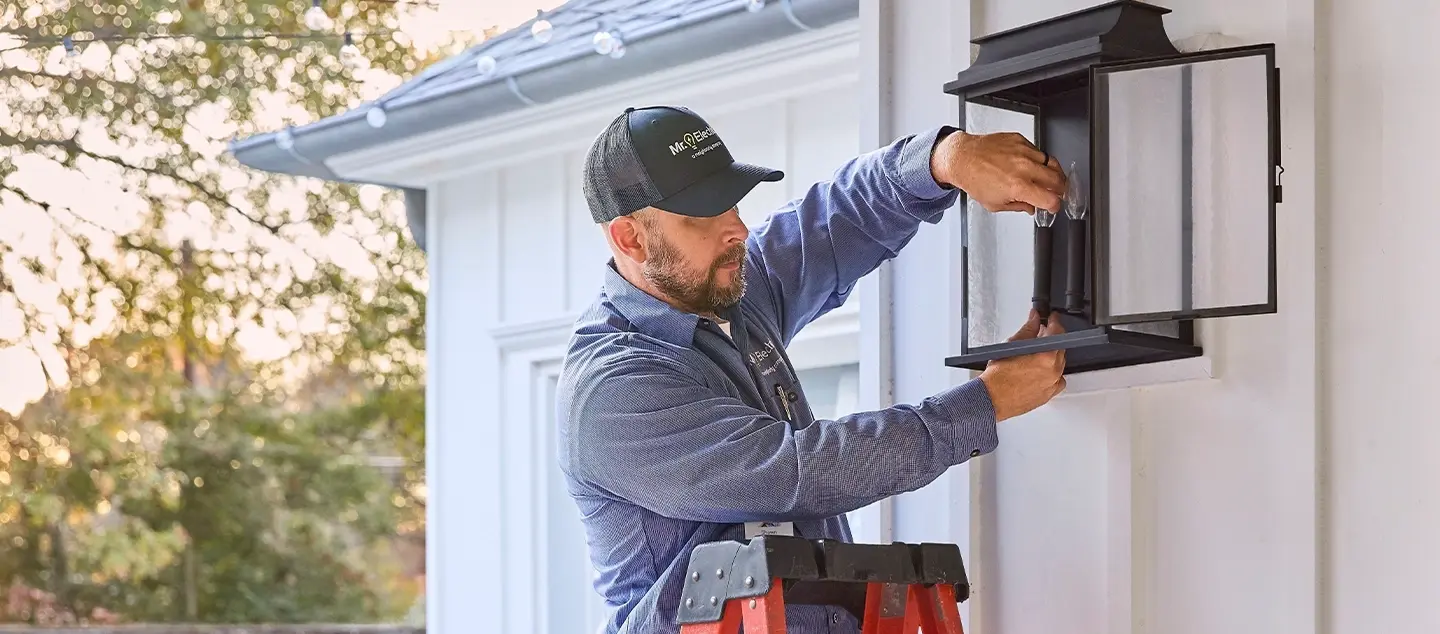
Licensed Electrician Newark, DE Residents Trust for Safe, Reliable Electrical Services
Your home's electrical system is not something to leave to chance. Mr. Electric® of Newark is a locally owned and operated franchise serving Newark, Bear, Wilmington, and all of New Castle County. We provide residential and commercial electrical services backed by upfront flat-rate pricing and the Neighborly Done Right Promise®, as part of the Neighborly family of home service brands founded in 1994.

Book Online

A representative from our office will get back to you shortly to schedule service.
Due to a system error, we did not get your request. Please call us for immediate assistance.
We don't currently provide service to this ZIP/Postal code.
Yes! You can email me service reminders and other messages.
Mr. Electric, a Neighbourly Company on its own behalf and on behalf of and its affiliates and franchisees requests your consent to send promotional and other electronic messages to you concerning products and services they believe are of interest to you. By checking this box, you agree to receive these messages. You can unsubscribe at any time.
Text opt-in does not apply for Canadian residents.
Customer Reviews
View All Testimonials
The Neighborly Done Right Promise® delivered by Mr. Electric®, a proud Neighborly company.
Easy Online BookingResidential and Commercial Electrical Services in Newark, DE
Older homes in Newark, especially those built before 1990, often carry electrical systems designed for a fraction of today's demand. Our licensed electricians diagnose the root cause of every electrical problem, explain the findings in plain language, and complete the work to National Electrical Code standards with a permit and inspection where required. We serve Newark-area homeowners, landlords, and business owners throughout New Castle County. Whether it’s a light fixture installation or emergency repairs, you will get the quality service you deserve when you contact us.
-
Installations
Learn more InstallationsOur electricians in Newark can install circuit breakers, power conditioners, and more.
-
Lighting
Learn more LightingNeed help installing bathroom or landscape lighting? We’re available when you need us!
-
Electrical Safety
Learn more Electrical SafetyOur professionals will install tamper-resistant outlets to protect children from their curiosity.
-
Repairs
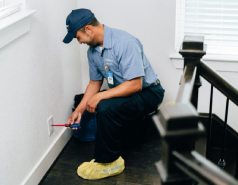
Learn more RepairsFrom ceiling fans to electrical panels, call our experts when you need electrical repair near you.
Let us know how we can help you today.
Why Newark Residents Choose Mr. Electric
-
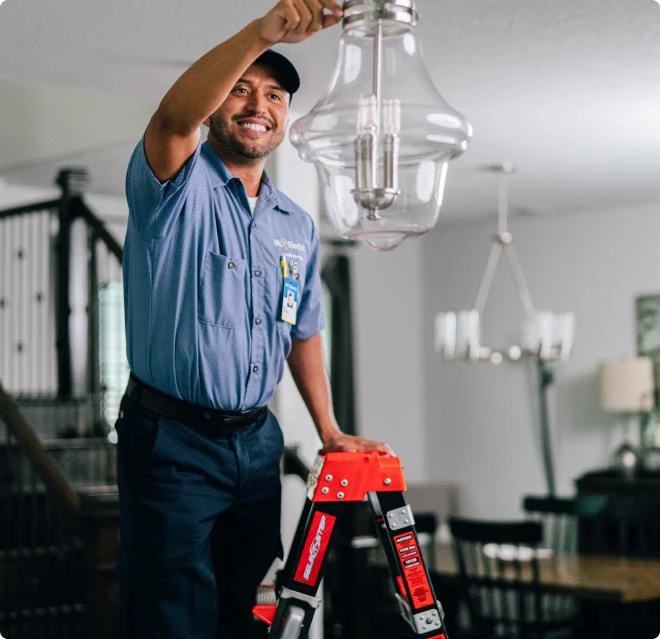
Every electrician on our team holds a current Delaware license issued by the Delaware Division of Professional Regulation. Delaware requires a minimum of 8,000 hours of supervised apprenticeship work, roughly five years in the field, plus a passing score on the state licensing examination, before any electrician earns their Journeyman license. Our team includes both Journeyman and Master Electricians. Master Electricians hold additional experience requirements and are the only license class authorized to pull permits and supervise electrical projects in Delaware. Before any electrician enters your home, we verify their license, conduct a background check, and complete drug screening. Our Newark electricians arrive on time, in uniform, wear shoe covers to protect your floors, use drop cloths where needed, and clean up after themselves before they leave.
-
We quote the job, not the hour. You receive a clear, written price before we start any work. If the repair takes longer than estimated, the price stays the same. Hourly billing creates uncertainty because the final cost depends on how long the job takes, rather than on what the job requires. Our flat-rate model gives you a number you agree to before we touch anything. No hidden fees. No diagnostic charges stacked on top of repair costs. We also offer financing options for larger projects, including panel upgrades, generator installations, and whole-home rewiring.
-
Mr. Electric of Newark is locally owned and operated, serving Newark and New Castle County as part of the community we live and work in. We are also part of Neighborly, the world's largest home services company, with more than 30 brands and 5,500 franchises across North America. Mr. Electric, as a brand, has been serving communities since 1994. That means you get the accountability of a local electrical company in Newark backed by the training standards, systems, and guarantee of a national organization. Every job we complete is covered by the Neighborly Done Right Promise®. If we do not get it right the first time, we come back and make it right. No fine print. No runaround.
250 Corporate Blvd Suite D Newark, DE 19702, United States
Areas We Serve
Frequently Asked Questions About Electrical Services in Newark, DE
-
Our electrical services in Newark include:
- Electrical panel upgrades and service panel replacement
- EV charger installation (Level 2 / 240-volt)
- Standby and portable generator installation
- Whole-home surge protection
- Circuit breaker replacement and electrical troubleshooting
- Dedicated circuit installation (kitchen, HVAC, home office, pool, hot tub)
- GFCI and AFCI outlet and breaker installation
- Wiring upgrades, including aluminum wiring remediation and knob-and-tube replacement
- Recessed lighting, ceiling fan installation, and lighting upgrades
- Outdoor electrical, deck and patio lighting, and landscape lighting
- Smoke detector and carbon monoxide detector installation
- Smart home device installation and integration
- Commercial electrical services for Newark-area businesses
- Emergency electrical repairs, 24 hours a day
-
Call a licensed electrician in Newark if you notice any of the following:
- Circuit breakers tripping more than once a month on the same circuit
- Lights that flicker or dim when you run appliances
- Outlets or switch plates that feel warm to the touch
- Burning smell near any electrical component
- Buzzing or crackling from outlets or your panel
- Sparks when you plug in a device
- Discoloration around outlet covers
These symptoms point to problems ranging from overloaded circuits to loose wire connections that generate heat and damage insulation over time. According to the National Fire Protection Association, electrical failures and malfunctions accounted for an estimated 13 percent of all home structure fires between 2015 and 2019. The calls we receive most often from Newark homeowners start with flickering lights that have been going on for months. By the time we arrive, we typically find a loose neutral connection at the panel or a failing breaker. Both are fire hazards. Both worsen, not improve, over time.
If you see sparks, smoke, or discoloration near your panel, turn off power at the main breaker if safe to reach, and call an emergency electrician immediately. A warm outlet cover is not a minor nuisance. It signals heat buildup inside the wall, which means a loose connection or an overloaded circuit. Turn off that outlet at the breaker and schedule a service call the same day.
-
Most Newark homes built before 1990 arrived with 100-amp service. That capacity was adequate when the typical household ran a refrigerator, a few lights, and a television. Today, between central air conditioning, electric vehicle charging, home office equipment, and modern kitchen appliances, a 100-amp panel is routinely operating near its limit. You need a panel upgrade if your home has a 60-amp or 100-amp service panel and you experience any of the following:
- Frequent breaker trips
- Plans to install an EV charger
- Plans to add central air conditioning or a heat pump
- Panel that is more than 25 to 30 years old
You also need a replacement if your home has a Federal Pacific Stab-Lok panel or a Zinsco panel. Both brands have well-documented failure rates in which the breakers do not trip under overload conditions. A breaker that fails to trip is not protecting your home. It is allowing a dangerous amount of current to flow through wiring that was not designed to carry it. In our experience serving New Castle County, roughly one in three homes built between 1965 and 1985 still has the original electrical panel. Many of those are Federal Pacific models. We treat these as safety replacements, not optional upgrades.
A licensed electrician performs a load calculation to determine whether your current panel meets your household's demand. The calculation adds up the amperage draw of all circuits and compares it to the panel's rated capacity. Most upgrades in Newark go from 100-amp to 200-amp service. A 200-amp panel provides 24,000 watts at 120 volts, enough to support an EV charger, central HVAC, a home office, and a fully equipped kitchen simultaneously. Additionally, if your panel has a brand label that reads "Federal Pacific," "Stab-Lok," "Zinsco," or "Sylvania," schedule an inspection before your next home insurance renewal. Several insurers in Delaware now require panel replacement as a condition of coverage.
-
A standard panel upgrade from 100-amp to 200-amp service follows this sequence:
- Your electrician pulls an electrical permit from the New Castle County Department of Land Use. Permit processing typically takes one to two business days.
- We schedule the work date and notify Delmarva Power to arrange a meter disconnect. Utility scheduling adds one to two business days in most cases.
- On the day of installation, the full job takes six to eight hours. Your power will be off for approximately two to four hours during the actual panel swap. We label every circuit clearly before we close the panel.
- After installation, we schedule a county inspection. New Castle County inspectors typically schedule within two to three business days of completion.
- The inspector verifies code compliance, signs off on the permit, and Delmarva Power reconnects the meter.
The timeline extends if your service entrance cable needs replacement, if the meter socket requires an upgrade, or if Delmarva Power needs to upgrade utility equipment at the same time. We coordinate directly with the utility, so you do not have to manage that process. We provide a complete timeline before we start, so you know exactly when your power will be off and when it will be restored. Schedule your panel upgrades for a weekday when you are home. County inspectors do not require the homeowner to be present, but having someone available to answer questions speeds the process.
-
The amperage rating of your electrical panel determines the total electrical load your home's system handles at one time. Here is how the two compare:
- 100-amp panel: Provides approximately 12,000 watts of capacity at 120 volts. Standard in homes built before 1990. Adequate for a basic home without central air conditioning, EV charging, or a home office. Typically has 20 to 30 circuit spaces.
- 200-amp panel: Provides approximately 24,000 watts of capacity at 120 volts. Current standard for new residential construction. Required for homes with central HVAC, EV chargers, electric ranges, or any combination of high-draw appliances. Typically has 40 circuit spaces. A 200-amp service also supports subpanel installation for additions, detached garages, or workshops without requiring a second utility connection. If you are planning any major electrical addition in the next five to ten years, upgrading to 200-amp service now is the practical choice.
-
A residential EV charging station installation in Newark requires a dedicated 240-volt circuit sized for your specific type of charger. Most Level 2 chargers draw between 32 and 48 amps continuously. Your electrician starts with a load calculation to confirm your electrical panel has enough available capacity to safely add that circuit. Understanding your charger options before installation helps you plan correctly:
- Level 1 charging: Uses a standard 120-volt outlet. Adds approximately 3 to 5 miles of range per hour. No installation required beyond a dedicated 20-amp circuit near the parking area. Practical only for plug-in hybrids or drivers with short daily commutes.
- Level 2 charging: Requires a 240-volt dedicated circuit, typically 40- to 60-amps. Adds approximately 20 to 30 miles of range per hour. Standard for most EV owners. Requires a licensed electrician for installation.
- NEMA 14-50 outlet: A 240-volt outlet that allows you to use a portable EVSE (Electric Vehicle Supply Equipment). Flexible option if you plan to switch vehicles. Requires a 50-amp dedicated circuit.
- Hardwired EVSE: A dedicated charging unit permanently wired to your panel. Slightly more efficient and typically faster than the outlet-based option. Requires a licensed electrician and a permit from New Castle County.
Many older Newark homes need a panel upgrade before EV charger installation because their existing 100-amp service does not have the available capacity to support a 40- to 50-amp charging circuit. Most EV charger calls we receive start with the same question: do I need to upgrade my panel first? The answer depends on your panel's age, its current amperage rating, and how many circuits are already in use. We assess all three before we quote anything.
New Castle County requires an electrical permit for Level 2 EV charger installations. The work must follow National Electrical Code Article 625, which covers electric vehicle charging systems. Outdoor installations require GFCI protection and weatherproof equipment rated for exterior use. Delaware residents qualify for rebates through Energize Delaware when installing qualifying EV charging equipment. Check energizedelaware.org for current program details before your installation date. If you are installing a Level 2 charger and your panel has available capacity, ask your electrician to run a 60-amp circuit even if your current charger only needs 40 amps. Future EV models charge faster and draw more current. Installing a larger circuit now costs very little extra and avoids a second project later.
-
Standby generator installation requires an electrical permit from New Castle County and a final inspection before you operate the system. Understanding the difference between your generator options helps you choose correctly:
- Standby generator: Permanently installed on a concrete pad outside your home. Runs on natural gas or propane. Starts automatically within seconds of a power outage. Requires a transfer switch, a dedicated gas line, and an electrical permit. Sized to power essential circuits or your whole home depending on the generator's output rating.
- Portable generator: Gasoline-powered. Requires manual setup and fuel management during an outage. Still requires a transfer switch for safe connection to your home's electrical system. Never connect a portable generator directly to a household outlet. Doing so backfeeds power into utility lines, creating a deadly hazard for Delmarva Power line workers.
The transfer switch is not optional. National Electrical Code Article 702 requires a transfer switch or interlock device on any generator connected to your home's wiring. The transfer switch isolates your home's electrical system from the utility grid when the generator starts. Without it, your generator pushes power back through the meter and onto the street-level lines. Generators must also meet setback requirements from property lines, structures, windows, and doors to prevent carbon monoxide from entering your home. Carbon monoxide is odorless and fatal. New Castle County inspectors verify placement, transfer switch installation, grounding, and gas line connections before approving the installation.
After severe weather in New Castle County, requests for generator installations have increased sharply. Those who installed standby generators before the storm have heat, refrigeration, and medical equipment running within seconds of an outage. Portable generators require manual setup outside in the storm and carry serious carbon monoxide risks if used incorrectly. When sizing a standby generator, decide first whether you want to power essential circuits only (refrigerator, furnace, a few lights, and outlets) or your whole home, including central air conditioning. Essential-circuit systems typically require a 7-14 kW generator. Whole-home systems for a typical Newark house often require 20 kW or more. Your electrician performs a load calculation to determine the right size.
-
A whole-home surge protector, also called a service entrance surge protector or Type 1 SPD (Surge Protective Device), is a device installed directly at your electrical panel that absorbs voltage spikes before they reach your home's circuits and connected equipment. It works differently from a power strip surge protector, which only protects devices plugged into that strip. Voltage surges enter your home through the utility lines. Lightning strikes, Delmarva Power grid switching operations, and large appliances cycling on and off inside your home all cause surges. A single surge lasting less than a millisecond carries enough energy to damage the sensitive electronics in your HVAC system, smart appliances, home office equipment, and EV charger.
Newark and New Castle County experience active summer thunderstorm seasons. The area also sits within a region where grid switching events from Delmarva Power's transmission network produce low-level surges that accumulate damage over time. A whole-home surge protector addresses both sources. A Type 1 SPD mounts at or near your electrical panel and must be installed by a licensed electrician. It does not replace point-of-use surge strips for sensitive electronics like computers and televisions.
The best protection combines both: a whole-home device at the panel and quality surge strips at individual workstations and entertainment systems. If your home has a smart thermostat, a variable-speed HVAC system, a smart panel, or any appliance with a digital control board, whole-home surge protection is worth the investment. The cost of replacing one HVAC control board typically exceeds the combined cost of the surge protector and installation.
-
A GFCI (Ground Fault Circuit Interrupter) outlet monitors the flow of electricity through a circuit and shuts off power within milliseconds if it detects current leaking to an unintended path, such as through water or a person. GFCI protection prevents electrocution in locations where water and electricity are in proximity. The National Electrical Code requires GFCI protection in the following locations in residential construction:
- All kitchen countertop outlets within six feet of a sink
- All bathroom outlets
- Garage outlets
- Outdoor outlets
- Unfinished basement outlets
- Crawl space outlets
- Boathouse outlets
- Within six feet of a wet bar sink
- Pool, spa, and hot tub areas
GFCI protection comes from either a GFCI outlet (the outlet with TEST and RESET buttons) or a GFCI circuit breaker that protects all outlets on a circuit. Older Newark homes built before GFCI requirements were adopted in the NEC often have standard two-prong or three-prong outlets in these locations without GFCI protection. Replacing them is a straightforward upgrade that significantly reduces the risk of shock. If a GFCI outlet trips and will not reset, check whether another GFCI outlet on the same circuit has tripped first. In many Newark homes, a single GFCI outlet in a bathroom or garage protects multiple downstream outlets. Find the tripped outlet, reset it, and test the others. If the outlet trips immediately again, there is a fault in the circuit that requires professional diagnosis.
-
An AFCI (Arc Fault Circuit Interrupter) breaker detects the electrical signature of an arcing fault, which is the dangerous sparking that occurs when electricity jumps across a gap in damaged, loose, or corroded wiring. Standard circuit breakers protect against overloads and short circuits. They do not detect arc faults, which are the leading cause of electrical fires in residential wiring. The National Electrical Code requires AFCI protection for circuits serving bedrooms, living rooms, dining rooms, family rooms, and similar spaces in new construction and in circuits that are replaced or extended. Delaware follows the NEC, so any electrical work performed in your Newark home today must meet current AFCI requirements for the circuits involved.
Older Newark homes built before AFCI requirements were widely adopted often have standard breakers on bedroom and living area circuits. Upgrading these to AFCI breakers is one of the most cost-effective fire prevention measures available. Arcing faults inside walls do not always trip standard breakers. They smolder, ignite insulation, and spread before any visible sign appears. AFCI breakers sometimes trip due to normal appliance operation, a phenomenon called nuisance tripping. If your AFCI breaker trips when you run a specific appliance, the appliance is likely generating an arc-fault signal. Have a licensed electrician test the circuit before assuming the breaker is defective.
-
A dedicated circuit is an electrical circuit that serves a single appliance or outlet and shares no load with any other device. It runs from a single breaker in your panel directly to that appliance with no other outlets or fixtures connected along the way. Dedicated circuits prevent overloads on high-draw equipment and eliminate nuisance breaker trips caused by sharing a circuit between competing loads. The National Electrical Code requires dedicated circuits for the following applications in residential construction:
- Refrigerators (20-amp, 120-volt)
- Dishwashers (20-amp, 120-volt)
- Microwave ovens (20-amp, 120-volt)
- Garbage disposals (20-amp, 120-volt)
- Electric ranges and ovens (50-amp, 240-volt)
- Electric dryers (30-amp, 240-volt)
- Central air conditioning and heat pumps (varies by unit, typically 30 to 60 amps, 240-volt)
- Electric water heaters (30-amp, 240-volt)
- EV chargers (40 to 60-amp, 240-volt)
- Hot tubs and spas (50 to 60-amp, 240-volt)
- Pool pumps and equipment (varies)
- Home workshop equipment (varies by tool)
One of the most common service calls we receive in Newark involves a kitchen circuit that trips repeatedly. In most cases, a countertop appliance like a microwave or toaster oven shares a 15-amp circuit with other kitchen outlets. The NEC requires 20-amp dedicated circuits for kitchen countertop areas. Upgrading to a dedicated 20-amp circuit eliminates the problem permanently. If you are planning a kitchen renovation, home addition, or home office build-out, have an electrician assess your dedicated circuit needs before construction begins. Adding circuits during a renovation is far less expensive than cutting into finished walls later.
-
Follow these steps in order:
- If you see smoke, flames, or active sparking from electrical equipment, evacuate everyone from the home immediately. Call 911 from outside. Do not re-enter to retrieve belongings.
- For emergencies without active fire, turn off power at your main breaker panel if you reach it safely. Do not touch the panel if you see smoke, smell burning near the panel, hear buzzing from inside it, or notice heat radiating from it.
- Keep everyone away from the affected area. Do not touch exposed wires, damaged outlets, or any electrical component near the problem.
- Call a licensed emergency electrician. Describe what you observed: the smell, the sound, the location, and whether you turned off the main breaker.
- After severe weather, check your service entrance, which is where the utility lines connect to your home near the meter. Damaged or hanging wires require immediate attention from Delmarva Power at 1-800-898-8042. Do not touch utility lines yourself.
The most common emergency calls we receive in Newark involve a burning smell from an outlet or wall. In most cases, we find a loose wire connection that has been arcing inside the wall. Arcing connections cause house fires. This is not a situation to monitor and see if it resolves. Turn off the circuit at the breaker and call for same-day service. Store your electrician's phone number in your contacts now, before you need it. During an emergency, searching for a local electrician while managing a stressful situation wastes critical time. Other situations that require emergency electrical service:
- Outlets or panels that are hot to the touch
- Repeated breaker trips on the same circuit that will not reset
- Sparking when you plug in a device
- Partial power loss affecting multiple rooms in your home
-
New Castle County requires an electrical permit for the following work:
- Electrical panel upgrades and service panel replacements
- Service entrance replacements
- New circuit installations
- EV charger installations (Level 2 / 240-volt)
- Generator installations and transfer switch installations
- New construction and home additions
- Major rewiring projects
- Subpanel installations
- Any work involving your main electrical panel
New Castle County does not require permits to replace an existing outlet, light fixture, or switch with the same type, or to replace a circuit breaker with the same amperage. Your licensed electrician determines whether your specific project needs a permit and handles the application process. The New Castle County Department of Land Use issues permits and coordinates inspections. After permitted work is complete, a county inspector verifies that the installation meets National Electrical Code requirements and any applicable local amendments before the permit is closed.
A red flag we see regularly: contractors who offer to skip the permit to save time or money. Unpermitted electrical work fails home inspections during real estate transactions. It voids your homeowner's insurance coverage for any claim related to that work. It must be corrected at full cost before you sell or refinance your property. The short-term savings are not worth the long-term risk. Ask your Newark electrician for the permit number before work begins. Verify the permit status online through the New Castle County Department of Land Use portal. A permit on file means the work was done to code and inspected.
-
A circuit breaker trips when it detects one of three conditions:
- Overload: More amperage is flowing through the circuit than its rated capacity. This happens when too many devices are on the same circuit at once. A 15-amp circuit supplying a space heater, a hair dryer, and a lamp simultaneously draws more current than the breaker allows. The breaker trips to prevent the wiring from overheating.
- Short circuit: A hot wire and a neutral wire touch, creating a sudden and large surge of current. Short circuits trip breakers instantly and are often caused by damaged wiring, a faulty appliance, or a loose connection inside an outlet or switch box.
- Ground fault: Current takes an unintended path to ground, often through water, a damaged appliance, or a person. Ground faults in wet locations are the reason the NEC mandates GFCI protection in kitchens, bathrooms, and outdoor areas.
If the same breaker trips repeatedly, resetting it without finding the cause puts your home at risk. Frequent tripping also degrades the breaker itself. A breaker that has tripped many times over its life loses some of its ability to reliably protect the circuit. Older Newark homes with 100-amp panels often experience overload trips because the panel does not have enough capacity for modern electrical demands, not because any single appliance is defective. If a breaker trips and will not reset, leave it in the tripped position and call an electrician. A breaker that refuses to reset signals a persistent fault in the circuit that needs professional diagnosis, not repeated manual resets.
-
Newark's housing stock includes a significant number of homes built between the 1940s and the 1980s, particularly in neighborhoods near the University of Delaware, Barksdale, Fairfield, and older sections of Brookside. These homes share several common electrical issues:
- Federal Pacific Stab-Lok panels: Common in homes built between 1950 and 1990. Breakers in these panels have documented failure rates. They do not always trip during overload conditions. Several major insurers in Delaware now require replacement as a condition of coverage.
- Zinsco panels: Similar documented failure issues to Federal Pacific. Common in homes from the same era. Breakers fuse to the bus bar over time, making them impossible to reset or replace without replacing the entire panel.
- Aluminum branch circuit wiring: Used extensively in homes built during the 1960s and 1970s when copper prices spiked. Aluminum expands and contracts more than copper does with temperature changes, causing connections to loosen over time. Loose aluminum connections create heat and arcing. Remediation involves installing CO/ALR-rated devices at every outlet and switch, or replacing the aluminum wiring with copper.
- Knob-and-tube wiring: Found in downtown Newark homes built before 1950, particularly near the University of Delaware campus. Knob-and-tube has no ground wire, uses insulation that becomes brittle and cracks with age, and was not designed for the loads modern appliances require. Insurance companies increasingly refuse to cover homes with active knob-and-tube systems.
- Ungrounded outlets: Two-prong outlets lack the grounding conductor required by current code. They provide no protection against ground faults and do not support three-prong appliances without an adapter.
- Missing GFCI and AFCI protection: Homes built before GFCI and AFCI requirements were adopted in the NEC often have standard outlets and breakers in locations that now require shock and arc-fault protection.
An electrical safety inspection identifies all of these issues. Most older Newark home electrical problems are correctable without a full rewire, depending on the scope and condition of the existing wiring.
-
Delaware requires all practicing electricians to hold a current license issued by the Delaware Division of Professional Regulation, Board of Electrical Examiners, under Title 24, Chapter 14 of the Delaware Code. Delaware issues two primary license classes:
- Journeyman Electrician: Requires completion of 8,000 hours of supervised apprenticeship work (approximately five years) and a passing score on the state Journeyman Electrician examination. A Journeyman works under the supervision of a Master Electrician and performs field installation and repair work.
- Master Electrician: Requires holding an active Journeyman license for a minimum of two years, completing an additional 4,000 hours of journeyman-level experience, and passing the Master Electrician examination. Only Master Electricians are authorized to obtain permits, supervise electrical projects, and operate as an electrical contractor in Delaware.
All Delaware electrician licenses renew every two years. Verify that your electrician holds a current, active Delaware license through the Delaware Division of Professional Regulation's online license verification portal at dpr.delaware.gov. Hiring an unlicensed electrician in Delaware violates state law. Unlicensed electrical work fails code inspections, voids homeowner's insurance claims related to that work, and creates safety hazards that the homeowner is then responsible for correcting. Before any electrician enters your home, ask to see their Delaware license number and verify it online. A Delaware Electrical Contractor license is separate from a Journeyman or Master Electrician license. The contractor license covers the business entity and requires proof of liability insurance and workers' compensation coverage. Ask for both the individual electrician's license and the company's contractor license before work begins.
-
Delaware residents qualify for rebates through Energize Delaware, the program operated by the Delaware Sustainable Energy Utility. Current programs relevant to electrical work include rebates for Level 2 EV charger installations, LED lighting upgrades, smart thermostats, and whole-home energy improvements, including electrical system upgrades. Rebate amounts and eligibility requirements change periodically. Verify current offers at energizedelaware.org before scheduling your project, as some programs require pre-approval before work begins. Delmarva Power, which serves Newark and all of New Castle County, also offers residential energy efficiency programs that overlap with electrical upgrades. Check delmarva.com for current residential incentives.
When you upgrade your electrical panel as part of a broader energy efficiency project, such as adding a heat pump, EV charger, or solar-ready infrastructure, you qualify for incentives that would not apply to a panel upgrade alone. Your electrician provides the documentation and installation records needed for rebate applications. We help identify which programs apply to your project before we start work. Some Energize Delaware rebates require pre-approval before installation. If you apply after the work is complete, you forfeit the rebate. Contact Energize Delaware or ask your electrician to confirm the application sequence before scheduling your project.
-
Follow these steps before hiring any electrician in Newark or New Castle County:
- Verify the electrician's Delaware license is current and active at dpr.delaware.gov. A license number is not enough. Confirm the license is active, not expired or suspended.
- Confirm the company holds a Delaware Electrical Contractor license with current liability insurance and workers' compensation coverage. Ask for certificates of insurance before work begins.
- Read Google, Yelp, and Better Business Bureau reviews. Look specifically for comments about whether the company pulled permits, showed up on time, and stood behind their work when problems arose. Also, check out the customer reviews on the company’s website.
- Ask whether they provide flat-rate, upfront pricing. An electrician who quotes by the hour cannot give you a firm total before starting. Flat-rate pricing means you agree to the cost before any work begins.
- Confirm they pull permits for work that requires them. Any contractor who suggests skipping permits to save money is exposing you to insurance, inspection, and resale risk.
- Ask about their workmanship warranty. A contractor who backs their work with a written guarantee is telling you something about how they operate.
At Mr. Electric of Newark, every job comes with the Neighborly Done Right Promise®. If we do not get it right the first time, we come back and make it right. We pull permits, coordinate inspections, and document our work on every project. Be cautious of any electrician who provides a verbal quote over the phone without seeing the job first. Rough estimates are possible, but electrical work involves variables that require a site visit to provide an accurate quote. A reputable electrician schedules a diagnostic visit, assesses the work, and provides a written price before starting.
-
Delaware adopts the National Electrical Code as the state electrical standard. The NEC is published by the National Fire Protection Association and updated every 3 years. Delaware currently enforces the 2020 edition of the NEC. Local jurisdictions, including New Castle County, adopt the state standard and add local amendments where applicable. The NEC establishes minimum safety requirements for all electrical installations, covering wire sizing, circuit protection, grounding and bonding, GFCI and AFCI protection requirements, and service entrance specifications. It also sets installation methods for specific equipment, including EV chargers (Article 625), generators (Article 702), and swimming pools (Article 680).
NEC compliance is not optional. Every permitted electrical project in New Castle County is inspected against the adopted code edition. Work that does not meet code fails inspection and must be corrected before the permit closes. When you hire a licensed electrician in Newark who pulls permits and coordinates inspections, NEC compliance is built into the process. Remember, the NEC is a minimum standard. A licensed electrician follows code as the floor, not the ceiling. Where local conditions, equipment requirements, or safety considerations call for exceeding minimum code, a good electrician will tell you why and what it involves.
-
Every job we complete is backed by the Neighborly Done Right Promise®. If we do not get the work done right the first time, we come back and make it right at no additional cost to you. This is a straightforward workmanship guarantee with no fine print and no exclusions for the labor we perform. We also warranty the parts and materials we install according to the manufacturer's specifications.
Most electrical components carry manufacturer warranties ranging from one year to lifetime coverage, depending on the product type. Circuit breakers, panels, and service entrance equipment from major manufacturers typically carry warranties of 10 years or more. We provide documentation for every product we install so you know exactly what coverage applies. Our locally owned Mr. Electric franchise serves Newark and New Castle County, and our reputation in this community depends on the quality of our work. We do not move on to the next job until the current one is done correctly, inspected where required, and signed off by the homeowner.
-
Delmarva Power, a division of Exelon, provides electric service to Newark and all of New Castle County. The utility owns and maintains the power lines, transformers, meters, and infrastructure that deliver electricity to your home. Everything from the meter into your home, including your electrical panel, wiring, and outlets, is your responsibility as the homeowner. When you lose power, check first whether your neighbors have lost power as well. A neighborhood-wide outage is a utility issue. Report it to Delmarva Power. If only your home has lost power, the problem is inside your electrical system and requires an electrician.
During a panel upgrade in Newark, we coordinate directly with Delmarva Power to schedule the meter disconnect and reconnect. This coordination process typically adds one to two business days to the project timeline. We handle that scheduling so you do not have to navigate the utility's process yourself. Some panel upgrades also require Delmarva Power to upgrade the service entrance cable or meter socket on their side of the meter.
We identify these requirements during the initial assessment and factor them into the project timeline. Delmarva Power is responsible for the service drop (the wires from the utility pole to your home) and the meter. If you see a wire sagging or damaged between the pole and your house, call Delmarva Power immediately, not an electrician. That portion of the system is utility property.
-
Outdoor electrical work requires weatherproof materials, proper grounding, and GFCI protection on all exterior outlets per the National Electrical Code. All outdoor electrical work in New Castle County requires permits for new circuit installations. We pull the permit, complete the installation to code, and coordinate the inspection. We install and service the following outdoor electrical systems in Newark and New Castle County:
- Outdoor GFCI outlets (weatherproof, in-use covers required)
- Deck and patio lighting, including low-voltage and line-voltage systems
- Landscape and pathway lighting
- Exterior security and motion-sensor lighting
- Outdoor kitchen electrical (dedicated circuits for grills, refrigerators, and outlets)
- Pool, hot tub, and spa electrical (dedicated circuits, GFCI protection, bonding per NEC Article 680)
- Detached garage and outbuilding electrical (subpanel or dedicated circuits)
- EV charger installation in exterior or detached garage locations
-
We provide electrical services for retail spaces, office buildings, restaurants, medical offices, light industrial facilities, and more commercial properties in Newark and New Castle County. Commercial electrical work involves higher voltage systems, three-phase power, larger panel capacities, and stricter code requirements than residential work. Our licensed electricians hold the credentials required for commercial projects in Delaware. Contact us to discuss your commercial electrical project in Newark. We assess the scope, provide a written quote, and handle permitting through New Castle County. Some of the commercial electrical services we provide include
- Panel and service upgrades for commercial properties
- Tenant-improvement electrical work
- Dedicated circuits for commercial kitchen equipment
- Lighting retrofits and LED upgrades
- EV charger installation for commercial parking areas
- Data and communication wiring
- Emergency lighting and exit sign installation
-
Mr. Electric of Newark serves the following communities in New Castle County, Delaware:
- Newark (primary service area)
- Bear
- Glasgow
- Brookside
- Pine Creek
- Montchanin
- Winterthur
- Yorklyn
- Wilmington
- New Castle
- Hockessin
- Delaware City
If you are not on this list but are in New Castle County, contact us to confirm service availability in your area.
Our Blog
View All Blog PostsDangers of an Overloaded Circuit
Overloading an electrical circuit can cause some serious problems. While that may seem obvious, chances are that you’ve caused a circuit overload at least once in your life.
Read More
Is Your Electrical Outlet Not Working?
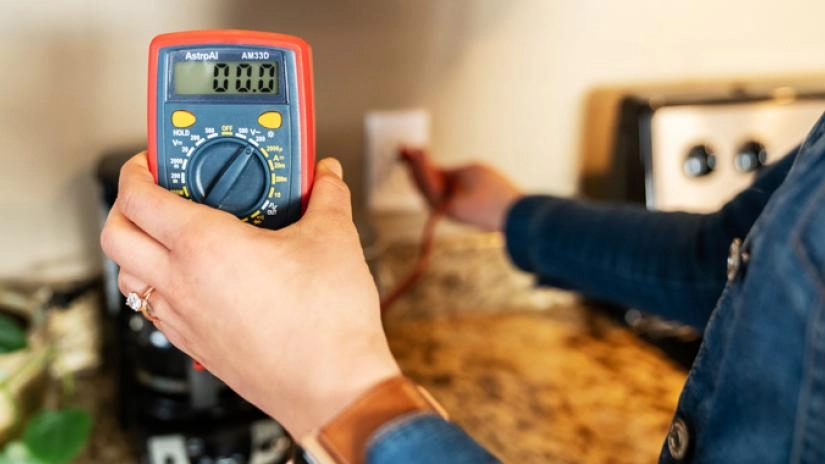
When the simple task of plugging your cell phone charger or hair dryer into the wall leaves you scratching your head and wondering why
Read MoreExpert Tips
View All Expert Tips

Top 8 Electrical Safety Essentials Your Home Needs
The cliche of "always be prepared" reigns true in most areas of life, but especially in homeownership. You never know when the next electrical storm will hit, when you'll suddenly notice mold and mildew in your basement, or when someone will attempt to break into your home. Even if you feel as though these things could never happen to you, it's better to be safe than sorry.
Read MoreSmart Devices: How Safe Are They?
The market for smart home products is worth an estimated $40 billion, with 65% of Americans already owning at least one device or system and a majority of those planning to purchase more in the future. People embrace this trend to increase security, improve energy efficiency, or gain more control over their home’s day-to-day functions.
Read MoreServices We Provide

-
Large Appliance Outlets
Outdoor Outlets
USB Outlets
Tamper Resistant Outlets
Outlet Installation
Outlet Repair
Safety Outlets
Panel Installation
Panel Upgrades and Repair
Circuit Breakers
Surge Protectors
Power Conditioners
Light Switches
Wall Switches
Knob and Tube Wiring Upgrades
Wiring Upgrades
Electrical Code Updates
Electrical Safety Check
Generators
Join Our Team
Yes. Inferior workmanship is something you never have to worry about when we're on the job. We provide high-quality work that we stand behind. That's why our team of professionals offers our Neighborly Done Right Promise®. This promise assures you that our trained electricians will get the job done right the first time, and if by any chance we don't, you have our promise that we'll come back and make it right. Guaranteed.

Your Source for Local Home Service Experts
Neighborly brands repair, maintain, and enhance properties — to make life easier and more enjoyable for homeowners. Our consistency and quality work are the basis for everything we do, and are what make us a leader in the home services space, as we constantly strive to "be so remarkable, we become a beloved household name."
Book Online
A representative from our office will get back to you shortly to schedule service.
Due to a system error, we did not get your request. Please call us for immediate assistance.
We don't currently provide service to this ZIP/postal code.
Yes! You can email me service reminders and other messages.
Mr. Electric, a Neighbourly Company on its own behalf and on behalf of and its affiliates and franchisees requests your consent to send promotional and other electronic messages to you concerning products and services they believe are of interest to you. By checking this box, you agree to receive these messages. You can unsubscribe at any time.
Text opt-in does not apply for Canadian residents.