
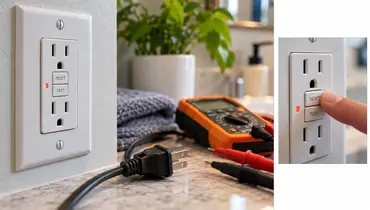
You press RESET on your bathroom outlet. Nothing happens. You try again, and it clicks, but your hair dryer still won't turn on. Or maybe the outlet works for a while before suddenly shutting off again. It's frustrating, especially when there's no obvious reason for the problem.
Here's what matters: The way your GFCI outlet behaves can tell you something about what's going wrong. A button that won't stay in isn't necessarily the same problem as an outlet that keeps tripping. Even that tiny indicator light can offer a clue.
Your GFCI (ground fault circuit interrupter) is designed to help protect you from electrical shock by interrupting power when it detects certain electrical imbalances. When it doesn't behave as expected, understanding the symptoms is a useful first step.
Let's look at what those warning signs can mean, what an electrician checks, and when Mr. Electric® can help.
What to expect in this article- What Do Different GFCI Outlet Symptoms Mean?
- Why Won't My GFCI Reset Button Stay In?
- Why Does My GFCI Reset but Still Have No Power?
- What Do GFCI Indicator Lights Mean?
- Why Does My GFCI Keep Tripping?
- How Do Electricians Diagnose GFCI Outlet Problems?
- When Should I Stop Using a GFCI Outlet?
- Continue Your Research
- Get Help Diagnosing GFCI Outlet Problems
What Do Different GFCI Outlet Symptoms Mean?
Two GFCI outlets can stop working for completely different reasons. One might be responding to a ground fault, while another has lost power somewhere along the circuit. This quick comparison chart can help you make sense of what you're seeing.
| What you're noticing | What it might mean | What to do next |
|---|---|---|
| RESET button won't stay in | Lost incoming power, active fault, incorrect wiring, or device failure | Have the underlying cause diagnosed |
| RESET clicks, but the outlet has no power | Internal contact failure or an electrical supply problem | Stop using the outlet and arrange service |
| GFCI trips immediately | A ground fault may still be present | Avoid repeated resets and contact an electrician |
| GFCI trips occasionally | Intermittent moisture, equipment, or wiring issues | Note when it happens and schedule an evaluation |
| Red or blinking indicator light | Model-specific warning, self-test, or fault condition | Refer to the manufacturer's instructions |
| Several outlets stop working together | Shared GFCI protection or another upstream problem | Note which outlets are affected |
Think of these symptoms as clues, not definitive answers. The same warning can have more than one cause.
If your outlet isn't operating normally, Mr. Electric offers electrical outlet repair services to help identify the issue and determine the appropriate solution.
Why Won't My GFCI Reset Button Stay In?
You press the button, expecting that familiar click, but it pops right back out. Does that mean you need a new outlet? Not necessarily.
Some GFCI outlets are designed to prevent resetting when they detect conditions that could interfere with safe operation.
A few possibilities include:
- No incoming power: Certain GFCI models need an active power supply before the RESET button can engage.
- An active ground fault: The outlet may be detecting an electrical problem that hasn't gone away.
- Incorrect wiring: Improper LINE and LOAD connections can prevent a GFCI from operating correctly.
- A failed internal component: Some self-testing GFCIs have a safety lockout that prevents them from resetting after certain failures.
Here's something homeowners often overlook: A GFCI that refuses to reset may actually be responding the way it was designed to.
For example, if a recently installed outlet has never worked, the problem could involve its wiring rather than a defective device. If an older outlet suddenly stops resetting, an internal failure or a new electrical fault may be responsible. An electrician can tell the difference without relying on guesswork.
Why Does My GFCI Reset but Still Have No Power?
Sometimes the RESET button clicks into place, but the outlet remains completely dead.
It's confusing because the button appears to be working. Unfortunately, a click doesn't guarantee that electricity is reaching the receptacle or that its protection is functioning correctly. The issue could involve worn internal contacts, a damaged connection, or a problem elsewhere in the electrical supply.
There's another clue worth paying attention to: Are other outlets without power, too? One GFCI can protect several downstream receptacles. For example, a GFCI in a bathroom might also protect another outlet connected to the same protected circuit. If several outlets stopped working together, that information can help your electrician narrow down the affected portion of the circuit.
The important distinction is between a RESET button that physically engages and an outlet that actually operates as intended. One doesn't automatically guarantee the other.
What Do GFCI Indicator Lights Mean?
Ever noticed a small green or red light on your GFCI outlet and wondered what it's trying to tell you? That light is a status indicator, but there's a catch: Not every GFCI manufacturer uses the same signals. Some models use green to show normal operation. Others display red during a self-test or when the device detects a problem.
Common GFCI indicator light meanings
| Indicator | Possible meaning |
|---|---|
| Solid green | Normal operation on many models |
| Solid red | A fault, trip, or device warning |
| Blinking red | A self-test sequence, fault indication, or a possible failure warning |
| Amber | A trip or another model-specific condition |
| No light | Normal on some models; loss of power or tripped status on others |
Indicator-light colors and patterns vary by manufacturer and model. Check the instructions for your specific GFCI before interpreting a warning light. If the warning persists or the outlet isn't working normally, contact a qualified electrician.
Why Does My GFCI Keep Tripping?
A GFCI that keeps tripping can be particularly annoying. One minute everything works; the next, the power is off again. Keep in mind that repeated trips shouldn't be dismissed as a nuisance. They can indicate that the outlet is detecting an ongoing or intermittent ground fault. The timing often also tells an important part of the story.
It trips immediately
When a GFCI trips as soon as it resets, a ground fault may still be present. Moisture, damaged equipment, or a wiring issue could be involved.
It trips when you use a particular appliance
Does the problem happen every time you turn on your hair dryer, coffee maker, or another appliance? That pattern may point to an electrical fault involving the equipment, its cord, or the circuit supplying it.
Stop using the suspected appliance until the issue has been evaluated.
It trips after heavy rain
Outdoor outlets and connected electrical equipment can be exposed to moisture, particularly when covers or seals have deteriorated. If tripping seems to follow rainy weather, mention that pattern to your electrician.
It trips at random times
Intermittent faults can be harder to pinpoint because they don't always appear on demand. Changes in moisture or equipment operation may affect when the GFCI trips.
A helpful tip: Pay attention to what was happening right before the power went out. Were you running an appliance? Had it rained? Did other outlets stop working? Those details can make a professional diagnosis more targeted.
How Do Electricians Diagnose GFCI Outlet Problems?
When a GFCI isn't working properly, replacing the receptacle might seem like the simplest solution but what if the outlet itself isn't the problem? That's why professional diagnosis matters.
Depending on the symptoms, a qualified electrician may:
- Check the power supply. Verify whether the outlet is receiving the expected voltage.
- Evaluate GFCI operation. Assess reset behavior, trip response, and relevant device functions.
- Inspect electrical connections. Identify loose, damaged, or improperly connected wiring.
- Investigate ground faults. Examine relevant circuit conditions and connected equipment for possible causes.
- Recommend the appropriate repair. Determine whether the solution involves a replacement receptacle, wiring repair, or another correction.
Not every situation requires every test. The electrician's findings determine what's necessary. For homeowners, the advantage is straightforward: You're addressing the actual source of the problem rather than replacing parts and hoping for the best.
Mr. Electric service professionals can diagnose malfunctioning outlets, explain what they find, and recommend repairs suited to your home's electrical system.
When Should I Stop Using a GFCI Outlet?
An outlet that doesn't work is inconvenient. An outlet showing signs of electrical damage is a different matter.
Stop using the GFCI and arrange professional service if you notice:
- Repeated or immediate tripping.
- A RESET that fails to restore normal operation.
- A TEST button that does not interrupt power.
- Persistent fault or failure indicators.
- A loose, cracked, or visibly damaged receptacle.
- Signs of water exposure or moisture intrusion.
Some warning signs require more urgent attention. If there's a burning odor, smoke, sparking, scorching, or unusual heat, don't touch or attempt to reset the outlet. Keep clear and seek urgent professional assistance. If there is smoke or fire, evacuate and call 911.
For basic resetting instructions involving an otherwise undamaged GFCI, see our existing GFCI troubleshooting guide.
Continue Your Research
Looking for more information about outlet problems or professional electrical services? These Mr. Electric resources can help.
- GFCI Outlet Won't Reset: Troubleshooting Tips and Precautions — Learn about basic reset precautions and troubleshooting.
- What to Do if an Electrical Outlet Stopped Working but the Breaker's Not Tripped — Understand why an outlet might lose power even when the breaker appears normal.
- GFCI Outlet Installation and Replacement — Explore professional installation and replacement services.
Get Help Diagnosing GFCI Outlet Problems
Whether your GFCI won't reset, keeps tripping, or displays a warning light you don't recognize, you shouldn't have to guess what's happening behind the wall. Mr. Electric® can help you get answers.
Our experienced service professionals diagnose outlet problems, identify electrical issues, and walk you through your repair options. We'll explain what needs attention so you can make an informed decision about your home. You'll also benefit from upfront pricing and workmanship backed by the Neighborly Done Right Promise®.
Let's get to the bottom of that GFCI problem. Schedule electrical outlet repair with Mr. Electric and get the professional help you need.
FAQs About GFCI Outlets
Your safety and the safety of your family and home are priorities for Mr. Electric service professionals. Below, we answer common questions about GFCI outlet problems, warning signs, and when to contact a qualified electrician. Our commitment also includes using our years of experience to answer your questions. Below are answers to some of the most frequently asked questions about GFCI outlet problems.