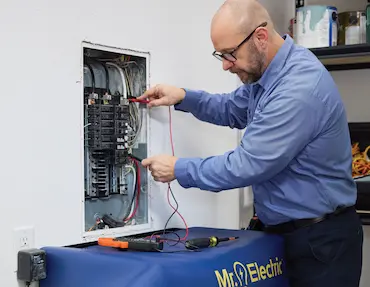
A home electrical safety inspection in Tampa is not a generic checklist. What a licensed electrician finds depends on when your neighborhood was built: pre-1950 bungalows in Seminole Heights and Hyde Park often have knob-and-tube wiring and 60-amp service; mid-century homes in Carrollwood and Palma Ceia commonly have aluminum branch-circuit wiring from 1965–1973; 1985–2005 subdivisions in Westchase and New Tampa typically lack surge and AFCI protection; and waterfront homes on Davis Islands and Bayshore face salt-air corrosion and dock-wiring compliance. A licensed inspection opens the panel, tests every protection device, and produces a written report with a repair quote typically $500–$1,000 in Tampa Bay.
Learn moreMr. Electric of Tampa Bay Blog
Shared Resources for Your Home Needs
National Electrical Safety Month: Your Guide to Checking Electrical Hazards in Your Home
May is National Electrical Safety Month, making it the ideal time to check the systems that homeowners rely on every day. Electrical hazards often develop quietly through overloaded circuits, aging panels, or outdated outlets until they become costly or dangerous problems.
Showing 22 Results for None
Mr. Electric of Tampa Bay serves South Tampa homeowners across the full peninsula, from the brick streets of Hyde Park to the deep-water canals of Culbreath Isles. But South Tampa is not one neighborhood with one type of home. It is ten distinct communities, each with its own architectural era, construction style, and set of electrical challenges that come with the territory. A 1920s bungalow in Hyde Park carries different electrical risks than a 1960s ranch in Virginia Park or a new-construction waterfront home in Davis Islands. Knowing the nuances of your Tampa home build matters when a breaker trips, a panel needs upgrading, or a homeowner wants to add an EV charger without overloading a 100-amp service that was never designed for it.
Learn moreThe right generator size for a Tampa Bay home is based on electrical load which circuits must run at the same time not square footage. Most Tampa homes land in one of three tiers: essential loads only (10–14 kW, no central AC), most-of-house backup including one AC system (18–22 kW, where most homeowners land), or whole-home backup (22–28+ kW). Because Tampa runs air conditioning nearly year-round and many homes have pool pumps and electric water heaters, loads run heavier than national averages. The exact size comes from an on-site load calculation under NEC Article 220.
Learn moreThe right backup power system for a Tampa Bay home is determined by neighborhood, not brand: your utility (TECO in Hillsborough, Duke Energy in Pinellas), whether natural gas reaches your street, your lot size and setbacks, HOA rules, and flood exposure decide whether a natural gas standby, a propane standby, or an Anker Solix E10 battery system makes sense. A complete, permitted 22 kW natural gas installation typically runs $12,000–$15,000 in 2026; propane $12,000–$17,000; and a fully configured E10 battery system $10,000–$15,000. All installations are governed by the 2020 NEC under Florida’s 8th Edition Building Code and require a permit.
Learn moreThe best holiday lighting for a Tampa Bay home matches the architecture: warm-white C9 bulbs tracing a Craftsman bungalow’s roofline and porch in Hyde Park, restrained up lighting on a Palma Ceia Mediterranean estate’s arches, long clean lines on a Carrollwood mid-century ranch, and water-facing displays with salt-rated fittings on Davis Islands. Getting it right also means getting the electrical right GFCI-protected outdoor outlets, circuits that will not trip on Christmas Eve, and weather-rated connections built for Florida rain. Mr. Electric of Tampa Bay does both: a licensed electrical contractor (EC13015799) and a CLIPA-certified holiday lighting installer that designs, installs with gutter-safe clips, maintains, takes down after the holidays, and stores your commercial-grade lights so nothing ends up in your garage.
Design consultations book up by mid-October. Call (813) 474-9789 or book online to reserve your holiday lighting design, install, and takedown across Hillsborough and Pinellas counties.
Most Tampa homes do not automatically need a panel upgrade before installing a Level 2 EV charger. Whether you need one depends on four things: your current service size, how much capacity your panel is already using, how much breaker space is available, and the amperage of the charger you want. A licensed electrician performs a load calculation under 2020 NEC Article 220 and reviews all four factors before recommending anything.
Learn more