Charging your electric vehicle overnight on a standard 120V outlet takes anywhere from 11 to 24 hours, depending on your battery size. A Level 2 charger at 240V drops that to 4 to 8 hours, and you wake up with a full charge every morning. Mr. Electric of Queensbury has served Hudson Falls and the surrounding Washington County area for years, and EV charger installations are among the most common calls we receive from homeowners switching to electric vehicles. We run a load calculation before we quote anything, check your existing electrical panel, verify grounding, and size the dedicated circuit to match your vehicle and your home's electrical system. As your local Hudson Falls electrician, we provide upfront, flat-rate pricing before any work starts. No hourly billing, no surprises at the end.
EV Charger Installation in Hudson Falls
Book Online

Let us know how we can help you today.
What Goes Into a Home EV Charger Installation in Hudson Falls
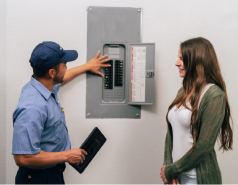
A Level 2 EV charger installation is not just plugging something in. The job starts with a load evaluation of your existing service panel by our Queensbury electrician. Most Hudson Falls homes have 100- or 150-amp panels, and if yours is already running near capacity, adding a 40- or 50-amp dedicated circuit for a charger can push the panel past its safe load limit. We check that first. If your panel needs an upgrade to support the new circuit, we will walk you through what that entails, what it costs, and how long it will take before any work starts.
Panel Capacity and Circuit Sizing
A standard Level 2 electric vehicle charging station draws between 16 and 32 amps continuously, and the NEC requires the circuit to be rated at 125% of the continuous load. That means a 32-amp charger needs a 40-amp circuit breaker on a dedicated circuit. Our electricians size the wire gauge and the breaker to match your charger's specs, which vary by manufacturer and vehicle. Getting this wrong trips breakers, generates heat, and degrades both the wiring and the charger over time.
Dedicated Circuit Installation and Code Compliance
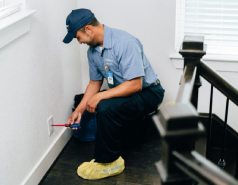
New York State follows the National Electrical Code, and Washington County requires a permit for new circuit installation. We pull the permit, schedule the inspection, and handle the paperwork. The dedicated circuit runs from your panel to the garage or parking area, with a wire gauge sized to the distance and load. Indoor garage installations typically use 6-AWG or 8-AWG wire on a 50-amp or 40-amp breaker. Outdoor installations use weatherproof conduit and a NEMA 14-50 or NEMA 6-50 outlet if you're using a plug-in charger, or direct wire for hardwired units.
Grounding Verification and GFCI Protection
Level 2 chargers require a properly grounded circuit. We test the grounding of the entire circuit run, not just the outlet. Many homes in Hudson Falls and Fort Edward built in the 1960s and 1970s have aluminum wiring in parts of the house, which requires special handling when connecting to modern copper circuits. Hardwired Level 2 chargers also require GFCI protection per the 2020 NEC, and we install that protection at the panel or at the charger location, depending on the unit.
Why Choose Mr. Electric of Queensbury for EV Charger Installation in Hudson Falls
Our electricians have an average of 15 years of field experience handling residential electrical work across Hudson Falls, Fort Edward, Lake George, Brant Lake, Warrensburg, and into Hamilton County. We know the local housing stock, the common panel brands in this area, and what Washington County inspectors look for in EV charger installations. Our service vehicles are fully stocked, which means fewer return trips and faster job completion.
Homes in Hudson Falls and the surrounding area range from 1890s craftsman builds to newer construction in Glens Falls and Queensbury subdivisions. Older homes often have panels that were installed before EV charging was a consideration, and upgrading them correctly requires experience with older equipment. We've replaced Square D, Siemens, and General Electric panels across the region, and we know how to spot panels that need replacement before they fail.
Every EV charger installation quote we give is flat-rate, written, and locked in before we start. If we find additional work is needed, such as a panel upgrade or remediation of aluminum wiring, we stop and tell you before proceeding. The Neighborly Done Right Promise® backs every job: if the work isn't done right, we make it right.
Frequently Asked Questions About EV Charger Installation in Hudson Falls, NY
Residential & Commercial Services