Skip to Main Content Skip to Footer Content

Electrical Panel Repair Lansing, MI

Lights dimming when the furnace kicks on. A breaker tripping every time the space heater runs. A warm, plastic smell near your electrical panel. These are signs you have a panel problem, and they won't fix themselves. Luckily, for homes with worn breakers, loose lugs, corroded bus bars, and overloaded circuits, Mr. Electric of Lansing handles electrical panel repair. Lansing, MI area homeowners have called us to fix electrical systems since 1992, so we know the equipment hiding in older local basements: 60-amp fuse boxes, Federal Pacific Stab-Lok units, and Zinsco boards with melted connections. Some of those panels need a single new breaker, while others are past saving and need replacing. Either way, you get a Lansing electrician who finds the cause, explains it in everyday terms, and fixes it.

Electrical Panel Repair Lansing, MI
Mr. Electric of Phoenix Metro electrician tools on a countertop in Phoenix, AZ.

Book Online

By checking this box, I agree to opt in to receive automated informational and promotional SMS and/or MMS messages from Mr. Electric, a Neighborly company, and its franchisees to the provided mobile number(s). Messages & data rates may apply. Message frequency varies. View Terms and Privacy Policy. Reply STOP to opt out of future messages. Reply HELP for help.

By entering your email address, you agree to receive emails about services, updates or promotions, and you agree to the Terms and Privacy Policy. You may unsubscribe at any time.

  • Guessing at a panel problem wastes your money. Our electricians take readings with the panel energized, wearing arc-rated gear, because a live panel shows more than a dead one. We check voltage on both legs at the main lugs, then put a clamp meter on each branch circuit to see which ones run hot under load. An infrared thermal camera picks up what your eyes miss. We also log the main breaker’s draw during peak use, which shows whether the service is close to its limit. Next, we pull the dead front cover and look for scorch marks, rust or white corrosion, pitted bus stabs, double-tapped breakers, and aluminum branch wiring without the right connectors. Moisture is a big one around here. Panels mounted on block walls in damp basements often show rust on the enclosure and white corrosion on the neutral bar. We also confirm the grounding electrode system is intact, from the ground rod clamp to the bond at the water line. Once testing’s done, you get a plain explanation of what failed and why, and photos of the problem spots.

  • Most panel repairs come down to a handful of fixes. Circuit breaker replacement is the common one. Breakers wear out after years of trips, and one that won’t reset, trips with nothing plugged in, or feels hot at the handle needs to come out. We match the replacement to the panel’s listing, so a Square D QO panel gets QO breakers, not a generic part that only looks like it fits. Loose connections come next. NEC 110.14(D) requires terminal screws to be tightened with a calibrated torque tool, and we follow the values printed on the panel label instead of guessing by feel. Under-torqued lugs arc and heat up. Over-torqued ones crack the terminal. We replace cracked or melted breaker housings on the same visit, never taping or gluing them back together. When a bus stab is pitted or burned, we replace the bus assembly where the manufacturer offers one, or we explain why the enclosure has to go. Double-tapped breakers get split onto separate breakers or pigtailed properly. Aluminum branch circuits from the late 1960s get AlumiConn or CO/ALR-rated connections. We also replace corroded neutral and ground bars and keep neutrals and grounds separated in subpanels, a mistake we find in plenty of garage and basement add-ons. Before we leave, every circuit gets labeled to match what it feeds. That directory matters at 2 a.m., when a breaker trips and the kitchen goes dark.

  • Some panel calls turn up trouble beyond the box itself. That’s where wiring updates come in. Lansing homes built before 1960 in neighborhoods like Old Town and the Eastside often still run on cloth-insulated wire, two-prong circuits with no ground, or a 60-amp service that never planned for a microwave, a window AC, and a home office running at once. Our electrical safety inspections walk the full system, from the meter base to the last outlet, and flag anything that fails to meet current code. Shelving, freezers, and storage bins end up stacked against the panel door, so we mark the floor to keep that 3-foot zone open after we leave. Whole house surge protection fits here too. A Type 2 surge device mounts at the panel and clamps voltage spikes from summer lightning and utility switching before they reach furnace boards and appliance controls. Each correction gets tested before we close the panel, and every GFCI device gets a trip test. Breaker labels get updated for each new circuit too. If a repair isn’t the right call for your home, we’ll say so.

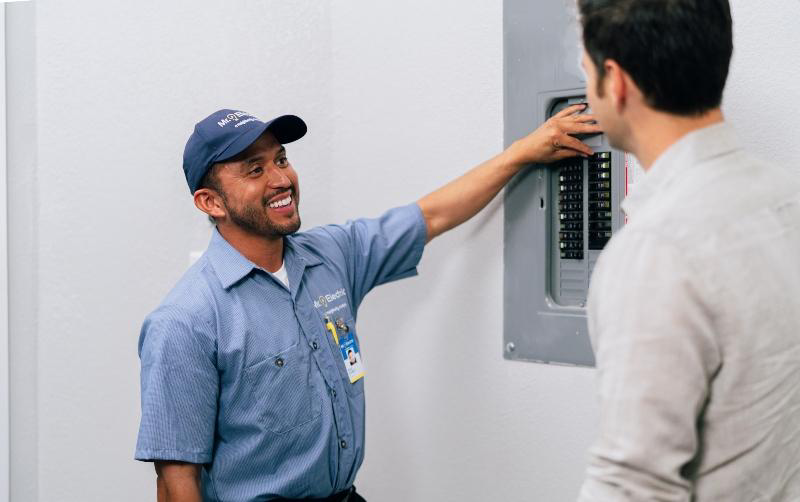
Mr. Electric electrician is talking about electrical panel repairs to a customer in Lansing.

Why Lansing Homeowners Call Mr. Electric for Panel Work

Mr. Electric of Lansing’s field crew averages more than 18 years in the trade. That’s not a sales line. It means the electrician opening your panel has likely seen your exact brand, your exact failure, and the shortcut a previous owner took. Our 29 field employees cover homes from Okemos and Haslett out to Grand Ledge, and every job is backed by the Neighborly Done Right Promise®. You’ll get an upfront price before work starts, based on the job and not a running clock, so a stubborn corroded lug doesn’t run up your bill.

Local knowledge matters with panel work. Lansing Board of Water & Light serves the city, while Consumers Energy serves many surrounding townships, and each utility has its own process for meter pulls and service disconnects. We coordinate with both, which keeps your outage short when a repair needs the power cut at the meter.

Our electricians wear shoe covers, lay drop cloths, and clean up before they leave. They also follow each NEC edition Michigan adopts, so a repair finished today still holds up when a future buyer’s inspector opens the cover. You get a written summary of every breaker and connection we touched—that record helps with insurance questions and resale paperwork years later. You’ll see the problem, hear the plan, and approve the price. Then we do the work.

FAQs on Electrical Panel Repair: Lansing, MI

  • A buzzing or crackling sound behind the panel door is the one we take most seriously. That usually means arcing at a breaker or lug. Other signs include a breaker handle that’s warm to the touch, rust streaks or water stains on the cover, scorch marks around a breaker, and lights flickering in several rooms at once instead of at one fixture. Two-prong outlets throughout the house hint that the panel and wiring date to the 1950s or earlier. Hear crackling? Keep the cover closed and call us.

bulb
Service You Can Trust!

Let us know how we can help you today.

Book Online

By checking this box, I agree to opt in to receive automated informational and promotional SMS and/or MMS messages from Mr. Electric, a Neighborly company, and its franchisees to the provided mobile number(s). Messages & data rates may apply. Message frequency varies. View Terms and Privacy Policy. Reply STOP to opt out of future messages. Reply HELP for help.

By entering your email address, you agree to receive emails about services, updates or promotions, and you agree to the Terms and Privacy Policy. You may unsubscribe at any time.