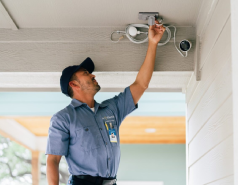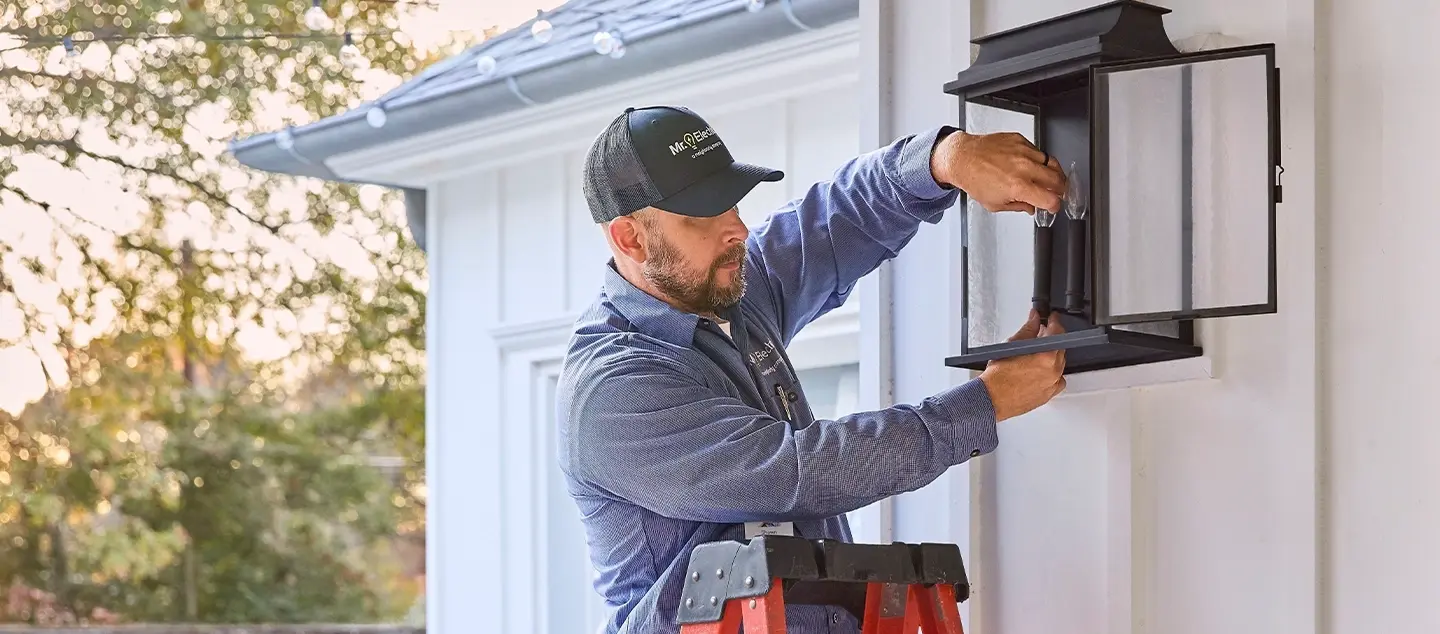
Licensed Electrician in College Station, TX
You may not see most of your home's electrical system every day, but a tripped breaker, a flickering light, or an outlet that stops working tells you something needs attention. Our licensed electricians in College Station diagnose what is wrong, explain it clearly, and fix it right. Mr. Electric® of Bryan & College Station proudly serves homeowners across the Brazos Valley, from Bryan and College Station to Southwood Valley and Pebble Creek.

Book Online
A representative from our office will get back to you shortly to schedule service.
Due to a system error, we did not get your request. Please call us for immediate assistance.
We don't currently provide service to this ZIP/Postal code.
Yes! You can email me service reminders and other messages.
Mr. Electric, a Neighbourly Company on its own behalf and on behalf of and its affiliates and franchisees requests your consent to send promotional and other electronic messages to you concerning products and services they believe are of interest to you. By checking this box, you agree to receive these messages. You can unsubscribe at any time.
Text opt-in does not apply for Canadian residents.
Customer Reviews
View All Testimonials
The Neighborly Done Right Promise® delivered by Mr. Electric®, a proud Neighborly company.
Easy Online BookingElectrical Services Built for College Station Homes
Most homes built before 2000 in College Station have 100-amp panels. Central AC, home offices, and modern electronics push that system past its limit. We upgrade panels to 200 amps and install 240-volt EV charger circuits. We wire whole-home generators and handle every wiring repair your home needs. Our TDLR-licensed electricians meet Texas electrical code and handle College Station permit requirements. We show up on time, protect your floors, clean up, and walk you through the work before we leave. Upfront pricing on every job. Neighborly Done Right Promise® on every result.
-
Installations
From minor repairs to major installations, Mr. Electric can assist you with your every need.Learn more Installations -

Lighting
We make your home or business safer and more beautiful with indoor and outdoor lighting solutions.Learn more Lighting -
Electrical Safety
We follow all federal, state, and local codes to ensure your safety and your structure’s security.Learn more Electrical Safety -
Repairs
For electrical repairs near you, trust the service professionals at Mr. Electric.Learn more Repairs

Let us know how we can help you today.
Why College Station Homeowners Choose Mr. Electric
-
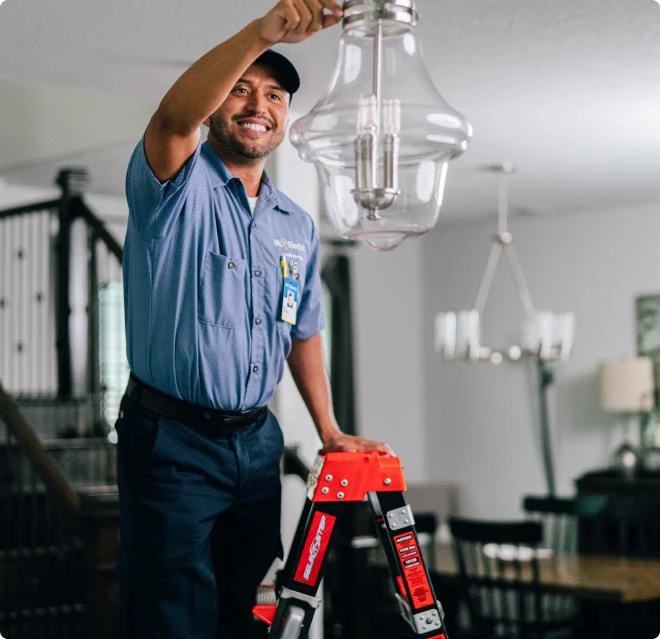
Mr. Electric of Bryan & College Station is locally owned and operated in the Bryan-College Station area. Our electricians hold Master Electrician and Journeyman licenses from the Texas Department of Licensing and Regulation (TDLR). We follow the National Electrical Code as adopted by Texas, pull permits, and schedule inspections through the City of College Station when your project requires one. You get local accountability backed by the training and reputation of a national brand established in 1994.
-
You get a clear price quote before any work begins. We charge by the job, not by the hour. No surprises, no hidden fees, no bill that creeps up while we work. You know exactly what you are paying before you say yes. If the scope changes, we will talk to you first. Financing options are available for qualifying projects. That is what upfront pricing means, and that is how we have done business for more than 30 years.
-
Mr. Electric is part of Neighborly, the largest home services company in the world, with more than 30 brands and 5,500 franchises. Every job we complete is backed by the Neighborly Done Right Promise®. If the work is not done right, we make things right. That covers the quality of our work and your satisfaction with the result. That is not a marketing slogan. That is how we operate every day.
2151 Harvey Mitchell Parkway S Suite 328 College Station, TX 77840, USA
Areas We Serve
Frequently Asked Questions About Electrical Services in College Station, TX
-
Mr. Electric of Bryan & College Station handles residential and light commercial electrical work across the Brazos Valley. Our TDLR-licensed electricians serve Bryan, College Station, and surrounding Brazos County communities. Here is what we offer:
- Electrical panel upgrades and replacements (100-amp to 200-amp service)
- Whole-home generator installation and automatic transfer switch wiring
- EV charger installation with dedicated 240-volt circuits
- Circuit breaker replacement and electrical troubleshooting
- GFCI and tamper-resistant outlet installation
- Ceiling fan and exhaust fan installation
- Recessed lighting, LED retrofit, and outdoor lighting installation
- Smoke detector and carbon monoxide detector installation
- Whole-home surge protection
- Dedicated circuit installation for appliances, hot tubs, and pool equipment
- Knob and tube wiring replacement and whole-house rewiring
- Smart home device wiring and integration
- Wiring repairs and upgrades
- 24/7 emergency electrical repairs
If your home was built before 2000 and still has a 100-amp panel, a 200-amp upgrade is one of the most common projects we complete in College Station. We size the new panel to your home's current and future electrical load, pull the permit through the City of College Station Development Services, complete the installation, and arrange the required inspection. The entire process takes four to six hours, and you will have power back the same day.
-
Most electrical work beyond simple repairs requires a permit from the City of College Station Development Services Department. The permit ensures the work meets the National Electrical Code and Texas state amendments, and it protects your home's value and your insurance coverage. Permits are required for:
- Electrical panel upgrades or replacements
- Service changes and meter base work
- New circuit installations
- Generator installations and transfer switch wiring
- EV charger installations (Level 2, 240-volt)
- Subpanel installations
- Dedicated circuits for appliances, pools, and spas
- Outdoor lighting circuits
You do not need a permit to replace an existing outlet, switch, or light fixture on an existing circuit. Our TDLR license number appears on every permit application we file, as required by Texas law. Texas also allows homeowners to pull their own permits for work on their primary residence, but unlicensed electrical work still voids your homeowner's insurance coverage and causes problems when you sell. We handle all permit applications and inspections so your project is documented and compliant from the start.
-
Your panel needs an upgrade if you notice any of these warning signs:
- Breakers trip frequently, especially during summer when AC runs constantly
- Buzzing or crackling sounds from the panel
- Scorch marks, rust, or corrosion on or around breakers
- Lights dim when large appliances start
- The panel is more than 25 years old
- Your home still has a 100-amp panel and you want to add an EV charger or generator
- The panel brand is Federal Pacific (Stab-Lok), Zinsco, or Pushmatic
Federal Pacific Stab-Lok panels and Zinsco panels deserve special attention. According to the U.S. Consumer Product Safety Commission, these panels have documented breaker failure rates in which breakers do not trip under overload conditions. That failure allows wiring to overheat and start fires. If your College Station home has either brand, replacement is the right move regardless of the panel's amperage rating.
Most homes in College Station built before 1990 have 100-amp panels. In older neighborhoods like Southwood Valley and College Hills, we regularly find Federal Pacific and Zinsco panels that need full replacement. A modern home with central AC, electric appliances, computers, and charging devices pulls more power than what a 100-amp system was designed to handle. If you plan to install an EV charger, you need a dedicated 240-volt circuit rated for 30 to 50 amps. A 100-amp panel often does not have the capacity to add that load safely. We perform a load calculation per NEC Article 220 to determine whether your panel handles your current and planned electrical demand. If the panel falls short, we recommend upgrading to a 200-amp panel.
-
We provide 24/7 customer service, which means you can reach us any time, day or night, seven days a week. True electrical emergencies come with immediate safety risks. If you have an electrical emergency, we'll dispatch a licensed electrician to assess the situation and make your home safe. If your situation is urgent but not dangerous, we schedule you for the next available appointment, often the same day or the next morning.
College Station's spring and summer storm season creates surges in emergency calls. If a storm knocks out your power, check whether your neighbors still have electricity. A neighborhood-wide outage is a Bryan Texas Utilities (BTU) or Oncor issue, depending on your service area, and you report it directly to your utility. If only your home lost power, the problem is likely inside your electrical system, and we handle that. When you call, our team asks questions to understand the problem, provides guidance on staying safe until we arrive, and gives you a clear expectation of when an electrician will be at your door. Emergency service rates apply for after-hours calls. We explain those rates when you call, so you know what to expect.
-
Electrical work involves real risk. A loose connection creates heat. Heat damages wire insulation. Damaged insulation causes arcing. Arcing starts fires. Under the Texas Occupations Code, Chapter 1305, the law requires a licensed electrician to perform most electrical installations and repairs. DIY electrical work voids permits, violates code, and puts your home and family at risk. Your homeowners' insurance policy requires that electrical work be performed by a licensed professional. If a fire or injury occurs as a result of unpermitted or unlicensed work, your insurance claim will be denied.
Our electricians hold TDLR Master Electrician and Journeyman licenses. They have completed the classroom training, documented apprenticeship hours, and passed state exams on electrical theory, code requirements, and safety practices. You verify any Texas electrician's license at tdlr.texas.gov using their name or license number before they start work. We carry liability insurance and workers' compensation coverage, so you are protected if something goes wrong on the job. Safety checks, such as resetting a tripped breaker or pressing the TEST button on a GFCI outlet, are fine for homeowners to do. Panel work, circuit installations, and any work involving live wiring is best left to a licensed professional.
-
A whole-home standby generator for a College Station home typically requires 18 to 24 kilowatts. A system powering essential circuits only needs 12 to 15 kilowatts. The right size depends on which loads you want to keep running during an outage. Common load estimates for sizing:
- Central AC unit: 3 to 5 kilowatts
- Refrigerator: 1 to 2 kilowatts
- Electric water heater: 4 to 5 kilowatts
- Lighting and outlets: 1 to 3 kilowatts
- Well pump (if applicable): 1 to 2 kilowatts
During the February 2021 winter storm, homes in Brazos County lost power for multiple days. As a result, requests for generator installations in College Station and Bryan increased significantly afterward. We also saw firsthand how homes with undersized generators had left critical systems unpowered while families endured subfreezing temperatures. Proper sizing prevents that outcome. Generac is the most widely installed residential standby generator brand in the U.S. and the brand we most frequently install in the Brazos Valley. Most residential standby generators run on natural gas from your existing BTU line or on propane from an on-site tank.
Natural gas is the preferred fuel in College Station because it eliminates the need to store and refill propane. Every standby generator installation requires an automatic transfer switch (ATS). The ATS detects the outage, starts the generator, and automatically switches your home to generator power, without any action on your part. We pull the electrical permit through the City of College Station, coordinate the gas line connection, and schedule the final inspection. Oversizing wastes fuel and costs more upfront. Undersizing leaves critical systems unsupported. We perform a load calculation before recommending a generator size.
-
Level 1 charging uses a standard 120-volt outlet and adds 3 to 5 miles of range per hour. Level 2 charging uses a dedicated 240-volt circuit and adds 25-37 miles per hour. Most College Station homeowners who drive electric vehicles daily benefit from Level 2 installation. Here is what that process involves. EV charger installation steps include:
- Electrical assessment to confirm your panel has capacity for a new 240-volt circuit
- Load calculation to verify available amperage
- Panel upgrade if your 100-amp panel does not have sufficient capacity
- Permit application to the City of College Station (required for Level 2 installations)
- Dedicated circuit installation with wire sized to the charger's amperage rating
- Conduit installation from panel to charger location
- Weatherproof enclosure installation for outdoor mounting
- Charger mounting and connection to the circuit
- GFCI protection per NEC 625.54
- Final inspection by City of College Station inspector
Most Level 2 chargers, called EVSE (Electric Vehicle Supply Equipment), require a dedicated 30 to 50-amp circuit. A Tesla Wall Connector needs a 60-amp breaker and 6-gauge copper wire. A ChargePoint Home Flex or JuiceBox 40 typically requires a 40- to 50-amp circuit. Additionally, smart chargers with WiFi connectivity allow for scheduled charging during off-peak utility hours, helping to reduce your electricity costs. If your home was built before 1990 and still has a 100-amp panel, plan to upgrade the panel as part of the EV charger project. A 40-amp charger adds about 30-37 miles of range per hour of charging, which covers most daily driving overnight.
-
The physical installation of a new 200-amp load center takes four to six hours. The full process from permit application to final inspection takes one to two weeks, with most of that time spent waiting for permit processing and inspection scheduling. Here is the complete panel upgrade process:
- Load calculation and system assessment (before scheduling)
- Permit application to City of College Station Development Services (1 to 3 business days to process)
- Utility coordination with Bryan Texas Utilities (BTU) or Oncor to arrange the meter disconnect (1 to 2 additional days)
- Installation day: shut off power at the main breaker, disconnect the old panel, install the new load center and breakers, transfer and reconnect all circuits
- Circuit testing and labeling (every circuit gets a clear label on the new panel directory)
- Power restoration and system verification
- City of College Station inspector verifies the work meets NEC and Texas code requirements
- Following inspection approval, the permit is closed and documentation filed
We recommend scheduling your panel upgrade for a mild day, as we will need to shut off power to your home. So it's best to schedule at a time when you can manage comfortably without AC or heat. If the inspection reveals a correction, we schedule a re-inspection at no additional charge to you. From permit approval to final inspection sign-off, most panel upgrades in College Station are completed within 7 to 10 business days.
-
Unplug everything on the circuit, reset the breaker once, and call a licensed electrician if it trips again. Repeated tripping is a warning, not a nuisance. Breakers trip for four reasons:
- Overloaded circuit: too many devices draw power at once, exceeding the breaker's rated amperage
- Short circuit: a hot wire and neutral wire make contact, causing a sudden high-current fault
- Ground fault: current leaks from the circuit to a grounding path, often through moisture
- Failing breaker: the breaker mechanism wears out after 20 to 30 years and trips even under normal load
Never replace a tripped breaker with one of a higher amperage rating. A 15-amp breaker on 14-gauge wire protects that wire from overheating. Installing a 20-amp breaker on the same 14-gauge wire removes that protection. The wire overheats and starts a fire inside your walls before the new breaker trips. During College Station summers, AC units running continuously push older circuits past their limit. That is the most common cause of summer breaker trips we see in homes built before 1990.
Two additional causes worth knowing: AFCI (arc fault circuit interrupter) breakers, required per NEC 210.12 in bedrooms and living areas, trip when they detect arcing signatures from damaged wiring or certain appliances. If your AFCI breaker trips repeatedly, the breaker is doing its job, and the wiring or a connected device needs evaluation. Double-tapped breakers, where two wires connect to a single breaker terminal, are a code violation and a common finding in older College Station homes. Double-tapping creates loose connections and heat. If your breaker feels warm to the touch, smells like burning plastic, or makes buzzing sounds, do not reset it. Call us immediately.
-
Call an emergency electrician immediately if you experience any of the following:
- Sparking or arcing from outlets, switches, or the electrical panel
- Burning smell from outlets, switches, or the panel
- Smoke coming from any electrical equipment or outlet
- Exposed wiring where insulation has melted or fallen off
- Complete power loss when neighbors still have electricity
- Water intrusion into your electrical panel or outlets after flooding or a storm
- A downed power line on or near your property (call BTU or Oncor first, then 911)
If someone receives an electric shock, call 911 immediately. Do not touch the person if they are still in contact with the electrical source. Shut off power at the main breaker only if you reach it without crossing the hazard area. If you see flames or active fire, call 911 first and get everyone out of the house. Before we arrive, shut off power at the main breaker if you reach it safely. Do not touch electrical equipment if you are standing in water or if the equipment is wet.
After College Station storms, water intrusion into panels and outlets creates shock and fire hazards that are not always visible. We provide 24/7 emergency dispatch for true electrical emergencies. A single outlet that stops working, a light fixture that needs replacement, or a breaker that tripped once and reset successfully are not emergencies. We schedule those for the next available appointment, often the same day or the next morning.
-
The City of College Station requires electrical permits for any work that involves your electrical panel or new permanent wiring. Here is what requires a permit:
- Panel upgrades, replacements, or service changes
- Meter base and service entrance work
- New circuit installations
- Generator and automatic transfer switch installations
- EV charger installations (Level 2, 240-volt)
- Subpanel installations
- Dedicated circuits for appliances, pools, hot tubs, and spas
- Outdoor lighting circuits and landscape lighting systems
Here is what does not require a permit:
- Replacing an existing outlet on an existing circuit (like-for-like)
- Replacing an existing switch on an existing circuit
- Replacing a light fixture on an existing circuit
- Resetting a tripped breaker
- Replacing smoke detectors on existing wiring
Our TDLR license number appears on every permit application we file, as required by Texas law. Permits ensure the work meets the National Electrical Code as adopted by Texas and gets inspected for safety. When you sell your home, the buyer's inspector checks for permits on major electrical upgrades. Missing permits will kill a sale or force you to open walls and bring unpermitted work up to current code. We handle all permit applications and inspections so your project is documented and compliant from the start.
-
Texas adopted the National Electrical Code, which requires GFCI protection in specific locations throughout the home. Per NEC 210.8, GFCI protection is required in:
- Bathrooms (all receptacles)
- Kitchens (all countertop receptacles within 6 feet of the sink)
- Garages and accessory buildings
- Outdoors (all receptacles)
- Crawl spaces and unfinished basements
- Laundry areas within 6 feet of the sink
- Boathouses and near swimming pools or hot tubs
A ground fault circuit interrupter (GFCI) detects when current leaks from a circuit and shuts off power in 0.025 seconds, faster than a heartbeat. This prevents electrocution when water or moisture creates a path for current to flow through your body to ground. GFCI protection is available as a GFCI outlet (with TEST and RESET buttons on the face) or as a GFCI breaker installed in your panel that protects an entire circuit. Both achieve the same protection. Test your GFCI outlets monthly by pressing the TEST button. The outlet should stop providing power. Press RESET to restore power. If the TEST button does not trip the outlet, the GFCI is faulty and needs to be replaced.
Per NEC 210.12, AFCI (arc-fault circuit interrupter) protection is required in bedrooms, living rooms, hallways, and most other living spaces. AFCI breakers detect arcing from damaged wiring and shut off the circuit before a fire starts. Combination AFCI/GFCI outlets and breakers provide both types of protection in a single device. If your College Station home was built before 2000, upgrading to GFCI and AFCI protection in required locations brings your home into compliance with current code.
-
College Station experiences 50 to 60 thunderstorm days each year, and Texas ranks second nationally in lightning-related insurance claims, according to the Insurance Information Institute. A direct lightning strike or a nearby surge sends thousands of volts through your electrical system in milliseconds. Here is how to protect your home:
- Install a Type 2 whole-home surge protector at your main electrical panel
- Add point-of-use surge protector strips for computers, TVs, and home office equipment
- Unplug sensitive electronics when severe thunderstorms approach
- Install a standby generator to maintain power during storm-related outages
- Have your whole-home surge protector inspected or replaced after a nearby lightning strike
The average lightning insurance claim costs $10,000 to $15,000 in damages. Your HVAC system is the most expensive item at risk because HVAC equipment is hardwired and not protected by a power strip. A whole-home surge protector installs at your main panel and diverts excess voltage to ground before the surge reaches your devices. These devices absorb surge energy measured in joules and wear out after absorbing major surges.
After the February 2021 storm, we replaced surge protectors in College Station and Bryan neighborhoods that had sustained direct or nearby lightning strikes. Replacing a worn surge protector costs a fraction of replacing an HVAC system or refrigerator. Point-of-use surge protector strips add a second layer of protection for sensitive electronics. During active thunderstorms, stay off corded phones and avoid using plumbing.
-
Your AC unit draws 15 to 20 amps at 240 volts during normal operation. The compressor startup pulls two to three times that amount for a split second as the motor comes up to speed. If your AC circuit is undersized, aging, or shared with other loads, the breaker trips to prevent overheating of the wiring. Many College Station homes built before 1990 were wired for smaller AC units, and modern high-efficiency systems draw more power under load. With AC systems running 180 to 210 days per year in College Station, a stressed circuit trips repeatedly during peak summer heat. That is the most common summer electrical complaint we receive across the Brazos Valley.
The solution is a dedicated 20- or 30-amp circuit sized correctly to meet your AC unit's electrical nameplate requirements. If your panel lacks space or capacity for a new circuit, a panel upgrade is the right fix. Never replace a tripped breaker with a higher-amp breaker without upgrading the wire gauge to match. A 20-amp breaker on 14-gauge wire allows the wire to overheat, melt the insulation, and start a fire inside your walls before the breaker trips.
If you are also having AC performance issues alongside the tripping, the problem is sometimes the HVAC system itself rather than the electrical circuit. A failing capacitor makes the compressor draw excessive startup current. A dirty condenser coil forces the compressor to work harder. In those cases, an HVAC technician addresses the mechanical issue while we handle the electrical circuit. We tell you which problem belongs to which trade before any work begins.
-
A 200-amp panel upgrade makes sense if your home has a 100-amp panel and you want to add an EV charger, a whole-home generator, or additional large appliances. Most homes in College Station built before 1990 have 100-amp service. When those homes were built, electrical demand was lower. A modern home with central AC, electric appliances, and standard electronics draws 150-200 amps at full load. A 100-amp panel limits what you add and causes frequent breaker trips when multiple systems run at once.
Two situations require panel replacement regardless of amperage: Federal Pacific Stab-Lok panels and Zinsco panels. The U.S. Consumer Product Safety Commission has documented that breakers in both panel types fail to trip under overload conditions. That failure allows wiring to overheat. If your home has either brand, replace the panel before adding any new loads. A subpanel is an alternative to a full-service upgrade in some situations. If your main panel has capacity but lacks physical space for new breakers, we install a subpanel fed from the main panel to add circuit capacity without replacing the service entrance.
A 200-amp panel gives you room to grow, prevents overload trips, and increases your home's resale value. Buyers in the Research Valley and Brazos Valley markets are increasingly seeking homes with adequate electrical capacity for EV chargers and smart home systems. We perform a load calculation to confirm whether your home needs the upgrade, and we size the panel to handle your current and future electrical demand.
-
Tamper-resistant outlets have spring-loaded shutters that block the electrical contacts. Both prongs of a plug must insert simultaneously to open the shutters. This prevents children from inserting objects such as keys, paper clips, or hairpins into a single slot, which can cause shock or electrocution. Per NEC 406.12, Texas requires tamper-resistant receptacles in all areas of homes accessible to children. The requirement took effect with the 2008 National Electrical Code. Approximately 2,400 children are treated in emergency rooms annually for electrical outlet injuries, according to the Electrical Safety Foundation International (ESFI). Tamper-resistant outlets reduce that risk by more than 90 percent.
If your College Station home was built before 2008, your outlets are not tamper-resistant. The upgrade is straightforward when outlets need replacement anyway. Tamper-resistant outlets look identical to standard outlets and work the same way when you plug in a device. When replacing outlets, consider upgrading to combination outlets with USB-A and USB-C ports for device charging, or to smart outlets that you control via a phone app or home automation system. Landlords in College Station are required to install tamper-resistant outlets in rental properties under local safety codes. If you own rental property near Texas A&M, this is a compliance item worth addressing.
-
Upfront pricing means you get the full price of your service before any work begins. Our electrician assesses the job by performing a visual inspection of your electrical system, testing relevant circuits, and identifying any code issues that need to be addressed. We explain what needs to be done, provide a fixed price covering labor, materials, permits, and cleanup, and wait for your approval before starting. We charge by the job, not by the hour. The price does not change unless the scope of work changes.
If we discover additional issues once we start, we stop, explain the situation, provide a price for the additional work, and wait for your approval before proceeding. This is different from hourly billing, where the meter runs while we work, and you do not know the final cost until the job is done. Hourly billing rewards slower work. Job-based pricing rewards efficiency. Financing options are available for qualifying projects, which makes larger upgrades like panel replacements and generator installations more manageable. That is how we have done business for more than 30 years, and that is how we earn repeat customers across College Station and Bryan.
-
Most routine electrical repairs are completed the same day we arrive. Here are typical timelines for common services:
- GFCI outlet replacement: 30 minutes
- Standard outlet or switch replacement: 30 to 45 minutes
- Circuit breaker replacement: 45 minutes to 1.5 hours
- Ceiling fan installation (existing wiring): 1 to 2 hours
- New 240-volt circuit for an electric dryer or appliance: 3 to 4 hours
- EV charger installation: 4 to 6 hours
- Electrical panel upgrade: 4 to 6 hours (plus permit and inspection time)
- Whole-home generator installation: 1 to 2 days
The timeline depends on what the repair involves, how easy the wiring is to access, and whether code updates are required alongside the repair. For example, replacing a bathroom outlet in an older College Station home often requires upgrading to GFCI protection at the same time to bring the work into compliance with current code. We include that in the upfront price, so there are no surprises. We provide a timeline estimate when we give you the price quote. We recommend scheduling electrical work on days with moderate weather when you can manage comfortably if the power needs to be off for a few hours.
-
If your College Station home was built between 1965 and 1973, there is a good chance the home has aluminum wiring. Check by looking at the wire markings on your electrical panel or in your attic. Aluminum wire is marked with AL or ALUMINUM on the cable sheathing. Copper wire has no such marking. Aluminum wiring is not immediately dangerous, but it requires evaluation and often requires remediation due to documented fire risk.
Aluminum expands and contracts more than copper when it heats and cools. Texas heat accelerates this cycle. Over time, connections loosen. Loose connections create heat. Heat increases resistance, which creates more heat, and eventually the insulation melts, and arcing occurs. The U.S. Consumer Product Safety Commission reports that homes with aluminum wiring are 55 times more likely to have fire hazard conditions at outlets than homes with copper wiring. Warning signs include warm outlets or switches, flickering lights, burning smells, and outlets that stop working.
Two approved remediation options exist. AlumiConn connectors are approved aluminum-to-copper connectors installed at each device location (outlet, switch, light fixture). This pigtailing approach addresses the hazard at each connection point without full rewiring. COPALUM crimping uses a specialized tool and connector to join aluminum wire to a short copper pigtail at each device. Both methods are approved by the CPSC.
Complete rewiring with copper is the most permanent solution and the right choice for homes with extensive aluminum wiring or where access is straightforward. When we inspect older homes in Southwood Valley and Oak Hills, we regularly find aluminum wiring. In many cases, AlumiConn connectors at each device location address the hazard at a fraction of the cost of full rewiring. An electrician should evaluate the aluminum wiring in an older College Station home before you buy it.
-
The electrical upgrades that add the most value to College Station homes are panel upgrades to 200-amp service, EV charger installations, whole-home surge protection, and updated outlets. Buyers in the Research Valley market, which includes College Station, Bryan, and surrounding Brazos County communities, are increasingly seeking homes with adequate electrical capacity for electric vehicles and smart home systems. Texas A&M faculty, staff, and professionals in the area are early EV adopters, and a dedicated 50-amp circuit ready for a charger adds real appeal. Additional upgrades worth considering before listing your home:
- Panel upgrade to 200-amp service (signals modern electrical capacity to buyers)
- EV charger installation or dedicated 50-amp circuit pre-wired for a charger
- Whole-home surge protection (valued in a market with 50 to 60 thunderstorm days annually)
- GFCI and tamper-resistant outlet upgrades in required locations (code compliance)
- LED recessed lighting retrofit (energy efficiency, modern appearance)
- Outdoor and landscape lighting (security and curb appeal)
- Smart home wiring and device integration (growing buyer preference)
- USB and smart outlet upgrades in bedrooms and kitchens
Electrical upgrades pay off most when completed before you list your home. Buyers see a move-in-ready property, and the home inspection flags no deferred electrical maintenance or code violations. Upgrades done during ownership also protect your family while you live in the home, which is a more important reason to address them. Whether you need repairs or upgrades, Mr. Electric of Bryan & College Station is here to help. Contact us today!
Our Blog
View All Blog PostsDangers of an Overloaded Circuit
Overloading an electrical circuit can cause some serious problems. While that may seem obvious, chances are that you’ve caused a circuit overload at least once in your life.
Read More
Is Your Electrical Outlet Not Working?
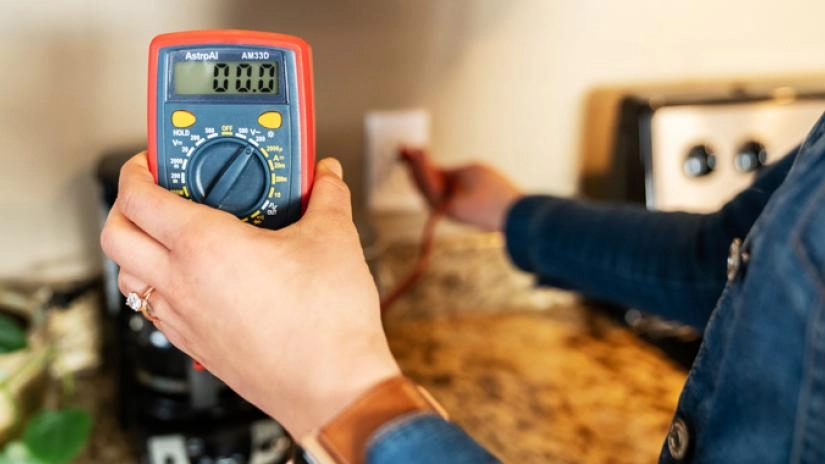
When the simple task of plugging your cell phone charger or hair dryer into the wall leaves you scratching your head and wondering why
Read MoreExpert Tips
View All Expert Tips

Top 8 Electrical Safety Essentials Your Home Needs
The cliche of "always be prepared" reigns true in most areas of life, but especially in homeownership. You never know when the next electrical storm will hit, when you'll suddenly notice mold and mildew in your basement, or when someone will attempt to break into your home. Even if you feel as though these things could never happen to you, it's better to be safe than sorry.
Read MoreSmart Devices: How Safe Are They?
The market for smart home products is worth an estimated $40 billion, with 65% of Americans already owning at least one device or system and a majority of those planning to purchase more in the future. People embrace this trend to increase security, improve energy efficiency, or gain more control over their home’s day-to-day functions.
Read MoreServices We Provide

-
Large Appliance Outlets
Outdoor Outlets
USB Outlets
Tamper Resistant Outlets
Outlet Installation
Outlet Repair
Safety Outlets
Panel Installation
Panel Upgrades and Repair
Circuit Breakers
Surge Protectors
Power Conditioners
Light Switches
Wall Switches
Knob and Tube Wiring Upgrades
Wiring Upgrades
Electrical Code Updates
Electrical Safety Check
Generators
Join Our Team
“We have the power to make things better.” That’s our mantra, not only for our customers' electrical issues, but also you, a future team member!

Your Source for Local Home Service Experts
Neighborly brands repair, maintain, and enhance properties — to make life easier and more enjoyable for homeowners. Our consistency and quality work are the basis for everything we do, and are what make us a leader in the home services space, as we constantly strive to "be so remarkable, we become a beloved household name."
Book Online
A representative from our office will get back to you shortly to schedule service.
Due to a system error, we did not get your request. Please call us for immediate assistance.
We don't currently provide service to this ZIP/postal code.
Yes! You can email me service reminders and other messages.
Mr. Electric, a Neighbourly Company on its own behalf and on behalf of and its affiliates and franchisees requests your consent to send promotional and other electronic messages to you concerning products and services they believe are of interest to you. By checking this box, you agree to receive these messages. You can unsubscribe at any time.
Text opt-in does not apply for Canadian residents.