More electric vehicles are on the road in Rock Hill than ever before, and public charging stations along Cherry Road or near Galleria Boulevard fill up fast. A home EV charger ends that problem for good. Mr. Electric of York - Rock Hill installs Level 2 EV charging stations for homes across Rock Hill, York, Fort Mill, Lake Wylie, and Tega Cay. Our licensed Rock Hill electricians assess your existing electrical panel, obtain the required permits from York County, and install a 240-volt dedicated circuit in accordance with the National Electrical Code. The whole process usually takes one day. You leave work, plug in, and wake up to a full battery. No planning around public charging schedules. No waiting in line at a fast-charge kiosk. Whether you drive a Ford F-150 Lightning, a Mustang Mach-E, a Rivian, a Tesla, or any other EV, the right home charging setup adds around 25 miles of range per hour on a Level 2 circuit. That covers most Rock Hill commutes overnight without a second thought.
EV Charger Installation Rock Hill, SC
Book Online
A representative from our office will get back to you shortly to schedule service.
Due to a system error, we did not get your request. Please call us for immediate assistance.
We don't currently provide service to this ZIP/Postal code.
Yes! You can email me service reminders and other messages.
Mr. Electric, a Neighbourly Company on its own behalf and on behalf of and its affiliates and franchisees requests your consent to send promotional and other electronic messages to you concerning products and services they believe are of interest to you. By checking this box, you agree to receive these messages. You can unsubscribe at any time.
Text opt-in does not apply for Canadian residents.
What Home EV Charger Installation in Rock Hill Involves
-
Most Rock Hill homes aren't wired for Level 2 charging right out of the box. A standard 120-volt wall outlet, what the industry calls Level 1 charging, adds about 3 to 5 miles of range per hour. Fine for a plug-in hybrid, but not practical for a full battery-electric vehicle with a 250-plus-mile range. A Level 2 charger runs on a dedicated 240-volt, 50-amp circuit and delivers 20 to 30 miles of range per hour, sometimes more depending on your vehicle's onboard charger rating.
-
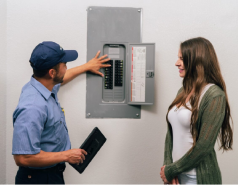
Here's what installation actually looks like. Our electrician starts with a panel inspection. Rock Hill homes built before the 2000s sometimes run 100-amp service panels, which limit the capacity available for new high-draw circuits. If your panel needs an upgrade to handle the additional load, we provide a quote for that work upfront before touching anything else. No surprises on the bill. From there, we run the circuit from your panel to your garage or driveway, mount the EVSE unit, and test it before we leave. The ChargePoint Home Flex and similar smart chargers connect to your home Wi-Fi and let you schedule charging during off-peak hours, which can cut your monthly energy bill if you're on York Electric Cooperative's time-of-use rate plan.
-
Permits matter here. York County requires an electrical permit for new 240-volt circuit installations, and the work must pass a final inspection. We handle the permit pull and coordinate the inspection so you don't have to. The Neighborly Done Right Promise® means if anything doesn't pass, we make it right at no additional cost.
Let us know how we can help you today.
Why Choose Mr. Electric of York - Rock Hill for EV Charging Station Installation in Rock Hill, SC
Licensed Electricians Who Know Local Code
Every electrician on our team is licensed and trained to South Carolina's electrical code requirements. EV charger installation isn't just drilling a hole in the garage wall. It involves load calculations, proper wire gauge for the run length, GFCI protection in certain locations, and a permit pull with York County. We do this correctly the first time.
Upfront Pricing Before Any Work Starts
You get a written, flat-rate quote before our electrician picks up a single tool. No hourly rates that climb while the job runs long. No surprises when the invoice arrives. If the job scope changes because we find a panel issue or need to run conduit through a finished wall, we will tell you before we proceed and provide a revised number for your approval.
The Neighborly Done Right Promise®, Backed by Neighborly
Mr. Electric is part of the Neighborly family of home services brands, established in 1994 and operating across nearly 200 locations. Every job we complete is backed by the Neighborly Done Right Promise®: if it's not done right, we make it right. That applies to every EV charger installation in Rock Hill, York, and the surrounding areas we serve.
Frequently Asked Questions About EV Charger Installation: Rock Hill, SC
-
The cost of a residential Level 2 EV charger installation in the Rock Hill area typically depends on how far the circuit needs to run, whether your electrical panel can handle the added load, and whether conduit work is needed. That does not include the EVSE unit itself, which ranges from around $200 for a basic 32-amp hardwired charger to $700 or more for a smart charger with Wi-Fi scheduling. According to the U.S. Department of Energy, the average cost of a home-level 2 charger and installation is between $1,000 and $2,500. Rock Hill homes built before 1990 often have 100-amp panels that need to be upgraded first, which adds to the project. We quote everything upfront so you see the full number before any work begins.
-
Yes. York County requires a permit for any new 240-volt dedicated circuit, including EV charger installations. The work also requires a final inspection before the circuit is considered approved. We pull the permit on your behalf, coordinate the inspection, and ensure everything meets current NEC standards. Skipping the permit process can put your homeowners' insurance at risk and create problems if you sell the property. Our team handles the entire permit process, so you have nothing to manage.
-
Yes. Outdoor installations are common, especially in Rock Hill neighborhoods where detached garages or carport parking are the norm. Outdoor EVSE units need to be rated for exterior use, and the circuit run requires weatherproof conduit and proper box covers. GFCI protection is required under the NEC for outdoor installations. We route the conduit neatly and ensure everything is sealed against Rock Hill's summer humidity and occasional ice storms. Some of our customers in areas like Lake Wylie and Newport have outdoor installs next to boat garages or RV pads, where we run a dual-purpose 50-amp circuit for both the EV charger and a 30-amp RV hookup.
-
The data support it. The National Renewable Energy Laboratory (NREL) found that Level 2 home charging is significantly more cost-effective per mile than public charging. For Rock Hill commuters driving 30 to 50 miles daily, the savings over public charging can exceed several hundred dollars per year. A properly permitted and installed 240-volt circuit also adds to home resale value; the National Association of Realtors has documented that EV charging capability is increasingly listed as a desirable feature by home buyers. Fort Mill, Tega Cay, and Rock Hill are seeing steady growth in EV adoption, and homes already wired for Level 2 charging stand out in that market. Beyond cost, the convenience of waking up to a full battery every morning is something most EV owners say they'd never give up.
-
Our team handles a full range of residential electrical work across Rock Hill, Fort Mill, York, and surrounding areas. That includes electrical panel upgrades and replacements, aluminum rewiring, generator installation and repair, surge protection, lighting installation, hot tub circuits, outlet and switch work, and emergency electrical repairs. We also serve light commercial properties. If you need to schedule an appointment or have a question about a job that isn't listed here, call our office, and we'll let you know whether it's within our scope.
-
There's no longer a federal tax credit for new home installs. Section 30C covered 30% of charger and installation costs, up to $1,000, but it ended for home chargers put in service after June 30, 2026. South Carolina doesn't have a state credit of its own. Utility rebates are where the savings are now. York Electric Cooperative gives members a $200 rebate on EV charging equipment installed at a YEC service address, and it also has a special EV rate for members who charge at home. Duke Energy has run residential EV programs in its South Carolina territory, but those change often, so check current terms before you buy anything. Here's what trips people up in Rock Hill: homes a few miles apart can be on different utilities. Many addresses inside city limits get power from the City of Rock Hill, while much of the surrounding area is on YEC or Duke. Check the name on your power bill first. It decides which program you can use.
-
For most Rock Hill garages, a hardwired Level 2 charger is the better long-term pick. It can deliver up to 48 amps, compared with the 40-amp limit on a plug-in setup, and there's no outlet to loosen or wear out from years of daily use. A NEMA 14-50 outlet still makes sense if you rent, expect to move soon, or want to take the charger with you. Code matters here too. The 2020 National Electrical Code, which South Carolina currently enforces, requires GFCI protection on outlets installed for EV charging (NEC 625.54).
Some chargers already have their own ground-fault protection and can nuisance-trip on a GFCI breaker. Hardwiring avoids that conflict. We also see a lot of cheap 14-50 outlets that have overheated in Rock Hill garages that hit 100 degrees in July. Heat and a heavy nightly load are hard on budget parts. If you go plug-in, we'll install an industrial-grade outlet, not the $10 one from the hardware store.
-
A 48-amp charger on a 60-amp breaker covers most battery-electric vehicles and delivers about 11.5 kW. For typical daily commutes, a 40-amp charger on a 50-amp circuit is plenty. The NEC treats EV charging as a continuous load, so the breaker has to be sized at 125% of the charger's output (NEC 625.41). That's why a 48-amp unit needs 60 amps, not 50. Your car sets the real limit, though. An EV with a 7.2 kW onboard charger won't pull more than about 30 amps, no matter what's mounted on the wall. The Ford F-150 Lightning goes the other way. Paired with Ford's Charge Station Pro, it can draw 80 amps and needs a 100-amp circuit. We see plenty of Lightnings around Rock Hill and Lake Wylie, and those installs usually need a full load calculation. On older 100-amp or 150-amp service, they often need a panel upgrade too. Tell us what you drive before we quote the job. It changes the wire size.
-
South Carolina homeowners can take on some electrical work in their own homes, but it still needs a permit and a passing inspection. A 240-volt EV circuit is one of the least forgiving DIY jobs in the house because it runs under a heavy load for hours every night. Small mistakes show up as heat: the wrong wire gauge for the distance, a loose lug at the breaker, or aluminum wire on terminals that aren't rated for it. The National Fire Protection Association estimates that electrical distribution and lighting equipment caused an average of 32,620 U.S. home fires per year from 2015 to 2019, with wiring and related equipment behind about two-thirds of them.
Some charger manufacturers also require installation by a licensed electrician to keep the warranty valid. Around Rock Hill, some of our EV calls are to fix DIY installs that failed inspection. Paying for the same job twice always costs more.
-
You can often charge two electric vehicles at home with power-sharing chargers. They split the available amps between two cars and adjust automatically when both are plugged in. Section 625.42 of the 2020 NEC allows this setup, as long as the system caps total draw at what the circuit can safely handle. Here's how the math works for two cars that each drive 30 to 40 miles a day. On a shared 60-amp circuit, 10 hours at 24 amps per car still adds well over 150 miles of range to each one. That's more than enough. More homes in Fort Mill, Tega Cay, and Rock Hill now have two EVs in the driveway. In a lot of those homes, power sharing is what separates a simple install from a $2,000-plus service upgrade. Ask us about it before you buy a second charger.
-
It will if you choose the Universal Wall Connector. That version has a built-in adapter for the J1772 plug used on most non-Tesla EVs, so one unit charges both. The plug situation is also changing fast. SAE standardized Tesla's connector as J3400 (you'll also see it called NACS), and Ford, GM, Hyundai, and Rivian have either switched to it on newer models or announced plans to. A charger you install today should still work for whatever you drive in 2035. For Rock Hill households with mixed garages, like a Model Y next to a Mustang Mach-E or an Ioniq 5, we usually recommend installing one universal unit instead of two separate chargers. It's cheaper, it uses a single circuit, and it keeps you from redoing the wiring when you trade in a car. We'll check your vehicle's port and onboard charger rating before recommending a model.
-
Ready for residential EV charging station installation service in Rock Hill, SC? Give us a call today to schedule Level 2 EV home charger installation with our pros. The experts at Mr. Electric of York - Rock Hill look forward to hearing from you!