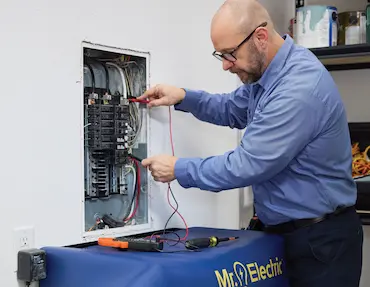
Electrical problems rarely announce themselves with a dramatic failure. They start with warning signs that are easy to dismiss: a loose outlet, lights that flicker when the AC kicks on, a breaker that trips once in a while, rust forming on the exterior disconnect, or a smoke alarm that chirps until someone pulls the battery. Each of these is a data point. Together, they paint a picture of whether your home’s electrical system is aging gracefully or heading toward a failure that could have been prevented.
Learn moreMr. Electric of Tampa Bay Blog
Shared Resources for Your Home Needs
National Electrical Safety Month: Your Guide to Checking Electrical Hazards in Your Home
May is National Electrical Safety Month, making it the ideal time to check the systems that homeowners rely on every day. Electrical hazards often develop quietly through overloaded circuits, aging panels, or outdated outlets until they become costly or dangerous problems.
All Blogs
If your dock lights stopped working, the most common causes are a tripped breaker or GFCI, a failed timer or photocell, corrosion inside fixtures or junction boxes, water intrusion in wiring or enclosures, or damaged conductors from age, storms, or improper installation. On a Florida waterfront property, a dock lighting failure should be treated as an electrical safety issue first — not just a lighting inconvenience.
Learn moreBoats, lifts, dock pedestals, and shoreline power systems all operate in one of the harshest environments for electrical infrastructure: constant moisture, salt air corrosion, UV degradation, and mechanical vibration. For Tampa Bay homeowners with private docks on Davis Islands, Tierra Verde, St. Pete, and Clearwater, marine electrical safety is not optional — it is a code requirement, a liability issue, and a life-safety imperative. The same applies to boat owners relying on marina shore power and marina operators managing multi-slip facilities.
Learn moreLighting is a meaningful slice of most home energy use, and as electric rates rise, many Tampa homeowners are looking for upgrades that actually move the needle. In neighborhoods like Sunset Park, Palma Ceia, Westchase, Bayshore Beautiful, and Virginia Park, the best results usually come from combining efficient fixtures with the right controls—not just swapping bulbs. In 2026, the biggest improvements aren’t just lower wattage—they’re better color quality, less glare, and controls that reduce wasted run-time automatically.
Learn moreFew topics in residential electrical work generate as much confusion as aluminum wiring. Homeowners hear that aluminum wiring is dangerous and assume every wire in the house is a fire hazard. Insurance inspectors flag it on 4-point reports and request remediation. Social media videos show burned connections and melted terminals. And yet, aluminum conductors remain a code-compliant, widely used material in modern residential electrical systems for specific applications.
Learn moreIf you live in an older home in Hyde Park, Carrollwood, Old Northeast, or Historic Kenwood, it’s worth remembering that the electrical system may be 40–80 years behind today’s demands. We often find a mix of older wiring methods, undersized service equipment, and missing safety protection—issues that can turn into nuisance breaker trips, damaged electronics, or (in the worst cases) fire risk. Some warning signs are just annoyances. Others are early indicators of overheating, arcing, or unsafe connections—problems that deserve a fast professional look.
Learn more