Your electric vehicle needs a charging solution that matches Highland Park's standards. The right home EV charging station turns your garage or parking space into a personal fueling station, letting you fully charge your vehicle overnight. Level 2 charging equipment cuts your charging time from 20+ hours to 4-8 hours compared to standard 120-volt outlets. Your home needs a proper electrical infrastructure to support these systems safely. That’s where Mr. Electric of Highland Park comes in. Our Highland Park electricians will ensure your new EV charger is installed safely and to code, meeting your electric vehicle charging needs.
EV Charger Installation Highland Park, IL
Book Online
A representative from our office will get back to you shortly to schedule service.
Due to a system error, we did not get your request. Please call us for immediate assistance.
We don't currently provide service to this ZIP/Postal code.
Yes! You can email me service reminders and other messages.
Mr. Electric, a Neighbourly Company on its own behalf and on behalf of and its affiliates and franchisees requests your consent to send promotional and other electronic messages to you concerning products and services they believe are of interest to you. By checking this box, you agree to receive these messages. You can unsubscribe at any time.
Text opt-in does not apply for Canadian residents.
Our Trusted Process for EV Charger Installation in Highland Park, IL
-
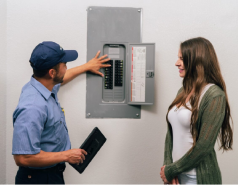
Our electrician will inspect your home's electrical panel, garage layout, and the distance between your service entrance and the desired charger location to determine the most efficient cable routing. But most importantly, we perform a professional load calculation to account for your HVAC systems, water heaters, and major appliances. This way, your home doesn't exceed its safe electrical capacity. If your property still utilizes an older 100-amp service, we will coordinate a seamless panel upgrade to provide the necessary 240-volt capacity for both current and future needs.
-
We handle the technical bureaucracy before a single wire is pulled. Our team will submit detailed permit applications to Highland Park building officials on your behalf. We'll also schedule any required inspections. Once the permit is approved, we'll start installing your dedicated 240-volt circuit. For attached garages, we'll run it along interior walls or through attic spaces, and for detached garages, we utilize specialized trenching, burying it at specific depths to protect your investment from frost heave. After the conduit is laid, our electricians make reasonable efforts to repair damage to landscaping and patch any structural openings.
-
The final phase of your Highland Park EV charger installation service focuses on hardware integration and safety validation. We securely mount your charging unit at the proper height for your vehicle's port location, follow strict torque specifications for all connections, implement robust grounding and weatherproofing, and conduct multi-point testing. We then perform a "live" charging test to confirm seamless communication between the charger and your vehicle's onboard computer. We coordinate the municipal inspection to ensure you receive the official documentation.
Let us know how we can help you today.
Why Choose Us for EV Charger Installation in Highland Park, IL?
Mr. Electric of Highland Park's team specializes in residential EV charging solutions, handling everything from electrical assessments and panel upgrades to hardwired installations. Here’s why residents call us for their home EV charger installation in Highland Park:
- North Shore Expertise. Your Highland Park property faces specific electrical challenges that differ from standard suburban homes. Our electricians have worked extensively with 1920s-era bungalows, mid-century ranches, and modern construction throughout Lake County. Your historic home's knob-and-tube wiring remnants, updated service panels, and unique garage configurations require electricians who understand local building evolution. You receive an assessment of your current electrical capacity, followed by recommendations for charging solutions that fit your actual infrastructure.
- Weather-Resistant Installation Standards. Highland Park's temperatures range from sub-zero to approaching 100F, placing outdoor installations under stress. You get weather-rated equipment and proper cable management to prevent ice damage and UV degradation. Your outdoor installations receive weatherproof enclosures and conduit protection. Detached garage runs require underground conduit buried below frost lines to prevent heave damage during freeze-thaw cycles in clay soil.
- Future-Proof Circuit Design. Your second EV purchase might happen sooner than expected as more family members switch to electric vehicles. We can plan circuits with expansion capacity, so you can install conduit and subpanels to accommodate additional chargers without a complete electrical system overhaul.
- Transparent Load Calculation and Permitting. Your installation begins with proper electrical load calculations that document available capacity for local inspectors to review. You receive complete permit application handling with the City of Highland Park, as well as scheduled inspections. Our work meets the current NEC electrical code; however, we are happy to work with you to meet your local code if it differs, and we provide documentation for insurance and future home sales.
FAQs About a Home EV Charger Installation: Highland Park, IL
-
Many properties in Highland Park were built between the 1920s and 1950s. Most may have updated electrical systems, but not all panels can handle the 40-60 amp draw required by Level 2 chargers. Your 200-amp service panel typically provides enough capacity. Homes with older 100-amp panels need upgrades. Additionally, the area's clay-heavy glacial till soil affects conduit placement for detached garages, as they require specialized trenching techniques to prevent frost heave damage during winter months.
These factors are part of the reason why your home charging solution starts with a thorough electrical assessment before any physical work begins on your EV charger installation. Our Highland Park electricians evaluate your existing service panel, measure available circuits, and calculate the total household electrical load. Many Highland Park homes have sufficient capacity, but some require dedicated circuit installation or panel upgrades. Your assessment identifies exactly what your property needs before installation begins.
A Level 2 charger installation delivers charging speeds 3-7 times faster than standard outlets. Your 240-volt circuit powers charging equipment rated between 16 and 80 amps. Most residential installations use 40-amp or 48-amp circuits. Your vehicle's onboard charger limits actual charging speed. A Tesla Model 3 Long Range accepts up to 48 amps while a Nissan Leaf Plus maxes out at 32 amps. Your electrician will match your circuit capacity to your vehicle's capabilities, avoiding over-installation that wastes money without improving performance.
Hardwired installations provide permanent, clean-looking charging solutions. Plus, they eliminate connections that can loosen over time, reducing potential failure points. Your electrician will mount the charger unit at optimal height for cable management, run conduit from your panel to the charger's location, and connect wiring according to the manufacturer's torque specifications. Your installation includes proper strain relief, cable organization, and mounting to structural members that support the equipment's weight.
NEMA 14-50 outlet installations offer flexibility if you prefer portable charging equipment or anticipate changing vehicles frequently. Your 50-amp outlet supports most portable EV chargers and provides future-proofing if you switch brands. Our electricians install weatherproof outlets and ensure proper grounding for safety. Your portable charger plugs directly into the outlet, giving you the option to take charging equipment when you travel.
-
We install all types of brands in accordance with manufacturer specifications and NEC standards. We install Tesla Wall Connectors, ChargePoint Home Flex, JuiceBox, Grizzl-E, and Emporia chargers properly. You receive hardwired installations that provide cleaner aesthetics than plug-in models, though NEMA 14-50 outlets are available if you prefer portable charging equipment. Your vehicle's onboard charger determines the actual charging speed, while your home electrical system delivers the maximum available power.
-
Mr. Electric of Highland Park provides EV charger installation throughout the community and the surrounding Lake County areas. This includes Ravinia, where many historic homes near the festival grounds require careful electrical upgrades that preserve architectural character. Moraine Township properties receive the same expert assessment and installation services, with attention to the area's mix of mid-century and modern construction. Sherwood Forest residents benefit from experience with the neighborhood's distinctive housing styles and garage configurations. Port Clinton homeowners receive specialized service for lakefront properties where moisture considerations affect installation methods. Professional EV charging solutions extend to all surrounding Lake County communities where North Shore residents need reliable, code-compliant electrical work. Other communities we service include:
- Kenilworth
- Winnetka
- Wilmette
- Bannockburn
- Riverwoods
- Knollwood
- Mettawa
- Northfield
- Long Grove
- Lake Zurich
- Kildeer
- Hawthorn Woods
- And more
-
Like most electrical installations, you need an electrical permit from the City of Highland Park to install an EV charger because the work involves new 240-volt circuits and modifications to your service panel.
The National Electrical Code requires permits for any permanent residential wiring project operating above 120 volts. To keep your project fully compliant, our licensed electricians handle every step: preparing load calculations, submitting detailed wiring diagrams, pulling the required municipal permits, and scheduling inspector visits. Skipping official permits can create significant liability during home insurance claims and stall future real estate transactions when buyers request proof of permitted work.
-
Most EV charger installations in Highland Park take 4-6 hours for attached garage locations where your panel has available capacity and requires only a dedicated circuit. Your installation timeline extends to 1-2 days if you need panel upgrades or detached-garage wiring that requires trenching for underground conduit.
According to the Electric Power Research Institute, it takes an average of 5 hours of labor to install a standard residential Level 2 charger when no electrical upgrades are needed. Outside of the physical work, Highland Park's permit and inspection process adds 5-10 business days between scheduling and completion, as inspectors must approve the installation before you legally use the charger. Weather conditions affect outdoor installations and trenching work during the winter months when frozen ground complicates excavation.
-
The cost of your EV charger installation in Highland Park varies based on factors such as whether you need an electrical panel upgrade and where your garage is located. Many homeowners need a panel upgrade to handle the increased electricity demand of an EV charger. We’ll perform load calculations to ensure your installation is safe and fully supported by your electrical system.
-
Your electrical panel can support an EV charger if you have 200-amp service with at least 40 amps of available capacity after accounting for all existing loads. Most Highland Park homes built or updated after 1980 have adequate service. But older properties with 100-amp or 150-amp panels often need upgrades.
The National Electrical Contractors Association recommends getting a professional load calculation done to verify capacity, as rule-of-thumb estimates often overlook important details about simultaneous electrical loads. Your electrician measures existing circuit loads, calculates the maximum demand factors for all appliances, and determines whether your panel can safely add a 40-50-amp charging circuit. Many Ravinia and Sherwood Forest homes have updated panels despite their age, but verification prevents dangerous overloads that trip main breakers or create fire risks.
-
The differences between the two chargers lie in their charging speed and needed electrical infrastructure. A Level 1 charging station uses a standard 120-volt household outlet and delivers 3-5 miles of range per hour, requiring 20-40 hours to fully charge most EVs. A Level 2 charging station uses 240-volt circuits and delivers 12-60 miles of range per hour, depending on the circuit's amperage and your vehicle's onboard charger capacity, and completes full charges in 4-8 hours for most EVs.
According to the U.S. Department of Energy, Level 2 chargers operate at 208-240 volts and typically provide 7.2-19.2 kW charging power compared to Level 1's 1.4-1.9 kW maximum output. Your overnight charging needs determine which system will work best for you. Most Highland Park EV owners choose Level 2 units to fully charge their vehicle during off-peak hours. Level 1 works for plug-in hybrids with smaller batteries but proves impractical for long-range EVs that deplete batteries during daily commutes.
-
Your electric bill increases based on how many miles you drive and your vehicle's efficiency, typically adding $30-$60 monthly for drivers covering 1,000 miles at ComEd's residential electricity rates. An EV charging 40 kWh to recover 150 miles of range costs approximately $5-$6 at Highland Park's average electricity rate of 12-14 cents per kWh. The U.S. Energy Information Administration reports Illinois residential electricity averages 13.01 cents per kWh, making EV charging significantly cheaper than gasoline at equivalent mileage rates. Your actual costs depend on ComEd's time-of-use rates if you enroll in programs that reduce overnight charging costs. Charging during off-peak hours between 9 PM and 6 AM typically cuts electricity costs by 30-40% compared to peak-hour charging, maximizing your savings from electric vehicle ownership.
-
You can install an EV charger in your detached garage, though it requires underground conduit running from your main panel to the garage. Your installation costs, though, will increase depending on distance, soil conditions, and whether existing landscaping requires restoration after trenching. Highland Park's clay-heavy glacial till soil requires trenching to depths of 18-24 inches to prevent frost heave from damaging buried conduit during winter freeze-thaw cycles.
The National Electrical Code requires underground wiring to use appropriate conduit rated for direct burial or concrete encasement in certain soil conditions. Your detached garage installation takes longer than attached garage work because trenching, conduit placement, and backfilling add significant labor. Some homeowners choose to install a subpanel in detached garages to support multiple circuits for charging, lighting, and workshop equipment.
-
Two-car EV households are growing fast in Highland Park, and the electrical math matters before you buy that second charger. A single 200-amp service panel can support two Level 2 chargers, but only when a proper load calculation confirms enough capacity remains after accounting for your HVAC, water heater, kitchen appliances, and existing circuits. Homes with 100-amp or 150-amp service almost always need a panel upgrade first.
One practical approach: install a garage subpanel dedicated to EV charging. A 60-amp or 100-amp subpanel gives each vehicle its own 40-amp circuit with room to grow. Some Highland Park homeowners also use smart load-management systems that automatically split available amperage between two chargers based on real-time demand. Your vehicles still charge overnight, and you never trip the main breaker.
The U.S. Department of Energy notes that smart charging systems reduce peak demand by shifting charge cycles to off-peak windows, which also cuts your ComEd bill. Our electricians will calculate your home's actual load, not a rule-of-thumb estimate, and lay out your options before any work starts.
-
Highland Park winters put real stress on EV charging equipment, and it's worth knowing what to expect before temperatures drop below zero. Most quality Level 2 chargers are rated to operate at temperatures as low as -22°F, which covers even the coldest Lake County nights. Outdoor installations require weatherproof enclosures, UV-resistant conduit, and cable rated for cold-weather flexibility so the cord doesn't stiffen and crack at the connector.
Battery chemistry also changes in the cold. Your vehicle's onboard battery management system will often precondition the pack before charging, drawing extra power to warm the cells to an efficient operating temperature. This means your car pulls more electricity from the charger during winter months than it does in July. A circuit sized for your summer charging needs still works fine in winter, but it's useful to know why your overnight charge sometimes takes longer in February.
For detached garages, the underground conduit run provides natural insulation for wiring, and burying below the frost line (typically 42 inches in Lake County) prevents heavy damage from Highland Park's freeze-thaw cycles. The Illinois Commerce Commission recommends working with licensed electricians on any cold-climate outdoor electrical installation where conduit depth and materials must comply with local frost requirements.
-
A properly permitted and inspected EV charger installation is treated as a permanent electrical improvement to your home, which most homeowners insurance policies cover under your dwelling coverage. Getting the permit matters here: unpermitted electrical work is a known reason insurers deny claims after a fire or electrical incident, and it creates disclosure obligations when you sell the home.
Some Illinois insurers have begun offering credits or riders for EV charging equipment, particularly for hardwired Level 2 systems installed by licensed electricians. It's worth calling your insurance provider after installation to confirm your policy reflects the improvement and to ask about any available discounts.
Our licensed electricians provide permit documentation and inspection sign-off after every installation, giving you the paperwork your insurer and future buyers will want. The National Association of Realtors has reported that EV-ready homes sell faster in markets where EV ownership is high, and Lake County's adoption rate continues to rise each year.
-
Your electric vehicle deserves a professional charging solution that prioritizes safety, code compliance, and optimal performance. Contact Mr. Electric of Highland Park to schedule your electrical assessment and receive detailed recommendations for your property. Our licensed electricians deliver turnkey EV charger installation from permit application through final inspection, ensuring your home charging station operates reliably for years ahead.
Call us to book your consultation today and transform your parking situation into a personal EV station. We also serve surrounding areas, including Arlington Heights, Des Plaines, and Skokie.