A public charging stop costs you time and money every single week. A Level 2 home charging station delivers 25 to 30 miles of range per hour, turning overnight parking into a full battery by morning. Mr. Electric of Downtown East Baltimore handles every step of the electric vehicle charger installation process, from load assessment to final inspection. Our Baltimore electrician team brings 10+ years of average field experience with residential electrical systems throughout the city, so the setup works properly when we leave.
EV Charger Installation Baltimore, MD
Licensed Electricians for Home Charging Station Setup
Book Online
A representative from our office will get back to you shortly to schedule service.
Due to a system error, we did not get your request. Please call us for immediate assistance.
We don't currently provide service to this ZIP/Postal code.
Yes! You can email me service reminders and other messages.
Mr. Electric, a Neighbourly Company on its own behalf and on behalf of and its affiliates and franchisees requests your consent to send promotional and other electronic messages to you concerning products and services they believe are of interest to you. By checking this box, you agree to receive these messages. You can unsubscribe at any time.
Text opt-in does not apply for Canadian residents.
Our Expert Service for Your Home’s EV Charger Installation: Baltimore, MD
-
A Level 2 charger runs on a dedicated 240V circuit, the same voltage supply used by a clothes dryer or electric range. Most drivers who cover 30 or more miles daily need Level 2 charging to keep up with their actual driving. The per-charge cost at home undercuts public charging rates in Baltimore by a significant margin over the life of the vehicle.
-
Electric vehicle supply equipment (EVSE) is the technical term for the wall-mounted charging unit. Most units use a J1772 connector, the North American standard accepted by every non-Tesla electric vehicle on the market. Tesla owners use either a J1772 adapter with any standard EVSE or the proprietary Tesla Wall Connector, which delivers up to 48 amps on a 60-amp circuit. Units with Wi-Fi or Bluetooth connectivity let you schedule charging during off-peak rate hours and track energy use through a phone app. Smart load-sharing firmware in multi-unit setups automatically splits available amperage between two vehicles, without tripping a circuit breaker.
-
Baltimore City and Baltimore County both require an electrical permit before any EVSE work begins. NFPA 70 Article 625 governs electric vehicle charger installations nationwide, specifying wire gauge, overcurrent protection, and dedicated circuit requirements for all EVSE work. A licensed electrical contractor pulls the permit, schedules the rough-in inspection after the circuit is in place, and arranges final sign-off once the charger is mounted and operational. Skipping this process creates problems at resale and voids most charger manufacturer warranties. Mr. Electric of Downtown East Baltimore files permits and manages inspection scheduling for every installation.
Let us know how we can help you today.
Why Baltimore Homeowners Choose Mr. Electric for Their EV Charger Installation Needs
When you’re on the search for a dependable electrician company, Mr. Electric of Downtown East Baltimore stands out as your trusted choice. Our electricians average 10+ years in the field, working across Baltimore's mix of rowhouses, detached homes, and older construction with varied panel configurations. Every job is backed by the Neighborly Done Right Promise®, which means the work meets code, passes inspection, and performs as installed. If something is off after we leave, we return and fix it. That standard applies to EV charger installation the same as every other service we provide. Not only do we offer EV charger installation services, but we also specialize in a wide range of other services, including panel upgrades, residential rewiring, and whole-home surge protection throughout Baltimore, including Dundalk, Pikesville, and Woodlawn. Scheduling online takes minutes, and our team confirms every appointment with a firm arrival window.
Contact us today for prompt responses and convenient scheduling. We look forward to hearing from you!
Frequently Asked Questions About Our EV Charger Installation: Baltimore, MD

-
Installation cost depends on the charger model, circuit run length, panel condition, and permit fees. A Level 2 charger installed on a 200-amp panel, with the main panel already near the garage, requires less than a project that would need new exterior conduit, a subpanel, or a full panel upgrade before the circuit is viable. Permit fees vary between Baltimore City and Baltimore County, but are typically factored into the full project estimate. Mr. Electric of Downtown East Baltimore provides a written estimate after reviewing your panel and discussing the charger model you plan to install. There are no hidden charges for permit coordination or inspection scheduling.
-
Maryland's Electric Vehicle Supply Equipment Rebate Program has provided residential rebates in prior program years. At the federal level, the Alternative Fuel Vehicle Refueling Property Credit on IRS Form 8911 covers a percentage of qualified EVSE costs, including installation labor, for eligible homeowners who drive zero-emission vehicles. The federal credit amount and income thresholds change with annual appropriations, so confirm the current figures with a tax professional before filing. Our team provides documentation of the installed equipment and circuit specifications that your accountant needs to accurately claim the credit. Keep installation records, the permit, and the final inspection approval on file for the filing process.
-
Outdoor charger installations are common across Baltimore rowhouse blocks and homes with detached garages or front-facing driveways. The charger requires a NEMA-rated weatherproof enclosure, exterior-grade conduit secured at code-specified intervals, and a circuit sized to the charger's rated amperage. Some neighborhoods with active community associations have guidelines on exterior electrical equipment placement, so check those rules before choosing a mounting location. Mr. Electric of Downtown East Baltimore handles citywide outdoor EV charger installations, including side-entry driveways and rear-alley setups, and manages all permit work for exterior installations.
-
Yes. Baltimore City and Baltimore County both require an electrical permit before any new circuit and EVSE installation work begins. The process includes a permit application, a rough-in inspection once the circuit is in place, and a final inspection after the charger is fully operational. A licensed electrical contractor files the permit application and pays the associated fee to the authority having jurisdiction. Working without a permit creates liability at resale and may result in the manufacturer denying warranty claims on an unpermitted installation. Mr. Electric handles the full permit process on your behalf from application through final sign-off.
-
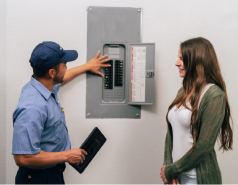
Homes with 100-amp service or panels at or near full capacity require a panel upgrade and replacement before adding a 50-amp EV circuit. During the assessment, our electricians check the total connected load, available breaker slots, and the panel's brand and age. Federal Pacific Stab-Lok and certain Zinsco panels found in older Baltimore construction have been documented to have reliability concerns and are frequently replaced as part of an EV readiness project. A new 200-amp panel with a full set of breaker slots gives you room for the EV circuit and capacity for a heat pump, electric dryer, or additional circuits down the road.
-
A straightforward Level 2 install with a short circuit run and a 200-amp panel in good condition typically takes three to four hours. Projects requiring a panel upgrade, long conduit runs, or exterior trenching take a full day or more. Keep in mind that the permitting process adds lead time before work begins, since the permit must be issued before the rough-in starts. Time will also be added for any inspections taking place. Our team gives you a realistic timeline when we provide our upfront pricing, so you can plan accurately around the job, not the other way around.
-
Maryland's statewide electrical code is based on the 2020 NEC, and Section 625.54 requires ground-fault circuit interrupter protection on any receptacle installed for EV charging, regardless of amperage or location. A plug-in charger on a NEMA 14-50 outlet needs a GFCI breaker or a GFCI-protected receptacle. Hardwired chargers rated above 60 amps are typically exempt, but most residential Level 2 units fall under this rule. The NFPA added the requirement because EV cords get plugged and unplugged outdoors and in damp garages more than a typical appliance cord. Mr. Electric of Downtown East Baltimore confirms the correct breaker and outlet setup before your rough-in inspection.
-
Yes, with the right load calculation, you can charge two electric vehicles from the same panel. NFPA 70 Article 625.42 requires an electrician to calculate total connected load before adding a second EV circuit, weighing the rest of the home's demand against both chargers. Many Baltimore rowhouses run on 100 amp or 150 amp service, which limits how much capacity remains for two 40 to 50 amp circuits without a panel upgrade. A load management device, or a smart charger with built-in load sharing, lets two vehicles split available amperage automatically and avoids nuisance breaker trips. Mr. Electric of Downtown East Baltimore checks your panel's capacity before recommending a shared circuit or a full upgrade.
-
Yes. Baltimore Gas and Electric runs a Vehicle Charging Time of Use rate that lowers the price per kilowatt-hour during off-peak hours, typically overnight and on weekends, while the rest of your home stays on your standard rate. BGE reports that a driver covering 15,000 miles a year can save around $120 annually by shifting charging into off-peak windows instead of the standard Schedule R rate. Enrollment requires a qualifying Level 2 charger that can track EV usage separately from the rest of the home's draw. Mr. Electric of Downtown East Baltimore installs Wi-Fi-enabled chargers that meet BGE's metering requirements.
-
It depends on where you park. A rear alley pad, a side yard, or a detached garage gives an electrician a clear path to run conduit from your panel to the charger. Roughly half of Baltimore's occupied housing units are attached rowhomes, and many of those blocks were built before dedicated parking existed, according to Baltimore Magazine's reporting on the city's row home stock. Running a charging cord across a public sidewalk to reach street parking creates a tripping hazard and blocks the public right-of-way, so Baltimore City will not approve that setup. If your home backs onto an alley or has side access, Mr. Electric of Downtown East Baltimore can usually find a route that stays within code.
-
A properly installed Level 2 charger tends to help your home's resale value, not hurt it. A Princeton University study published in Nature Sustainability analyzed 14 million California home sales and found homes near EV charging access sold at roughly a 3.3 percent price premium, about $17,000 on a median-priced home in that market. The results vary by city and by local EV adoption, but appraisers increasingly treat a wired charger as a fixed improvement.
On the insurance side, while it's best to check with your insurance company, most Maryland homeowners' policies do not require a separate rider for a code-compliant, permitted charger. However, your carrier may ask for the permit and inspection record if a claim ever involves the circuit.
-
Mr. Electric of Downtown East Baltimore installs Level 2 home charging stations, handles panel upgrades, and manages all permit coordination for EV charger installation projects across the city. Your home might need a simple 240V circuit addition or a complete panel overhaul before charging is viable. Either way, our team has completed that scope of work across Baltimore neighborhoods.
Contact us today to schedule your appointment with our trusted electrical professionals.