Mr. Electric of Citrus & Marion County provides complete residential EV charger installation from initial load calculations through final inspection. An installation complies with the requirements of NEC Article 625 and the 2023 Florida Building Code. You receive proper permit processing through the Citrus County Building Division and coordinated inspection scheduling. A charging station is served by a dedicated 240-volt circuit with GFCI protection and appropriate wire sizing for the distance to the panel. Florida's climate demands NEMA 4X-rated enclosures for outdoor installations and liquid-tight conduit for moisture protection. Our installation services offer protection for your investment while delivering safe, efficient charging every night. Gain the freedom to charge at home without searching for public stations in Crystal River or Inverness when choosing our Beverly Hills electricians.
EV Charger Installation in Beverly Hills, FL
Book Online
Why Choose Us for EV Charger Installation in Beverly Hills, FL?
Your electric vehicle needs reliable home charging that matches the performance and convenience you expect. In Beverly Hills, FL, installing an EV charger means more than mounting equipment on your garage wall. Your home's electrical system requires careful evaluation to handle the continuous 40-amp draw that Level 2 charging demands. According to our Crystal River electricians, many Beverly Hills properties feature original 100-amp electrical services from the 1960s and 1970s that were never designed to handle modern electric-vehicle loads. Your concrete-block home likely has a carport-mounted main panel exposed to Gulf Coast humidity and salt air, which requires weatherproof components and corrosion-resistant hardware.
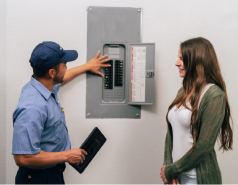
Your electrical system receives a comprehensive assessment before installation begins. Mr. Electric of Citrus & Marion County evaluates your panel capacity, measures available space for breakers, and calculates total household load. You learn whether your existing 100-amp or 150-amp service can support an EV charger alongside your air conditioning, water heater, and pool equipment.
- Complete Load Calculations: Your home receives NEC 220.82-compliant calculations that determine the exact capacity for EV charging without overloading the panel or service entrance conductors.
- Panel Upgrades When Needed: Your outdated Federal Pacific or Zinsco panel gets replaced with modern equipment rated for continuous high-amperage loads before the charging circuit goes live.
- Permit Processing and Inspections: The installation includes all necessary electrical permits from Citrus County Building Division, with coordinated inspection scheduling for final approval.
- Weatherproof Installations: Your carport or garage installation receives NEMA 4X-rated enclosures, stainless steel mounting hardware, and liquid-tight conduit that resist Florida humidity and salt air.
- Smart Charger Integration: The WiFi-enabled charging station connects to your home network to schedule, monitor energy use, and optimize charging during off-peak electricity rates.
- Code Compliant Every Time: The installation meets all NEC Article 625 requirements for GFCI protection, proper grounding, equipment disconnect, and labeling at the service panel.
Technical Requirements for Beverly Hills EV Charging Stations
A 240-volt dedicated circuit requires specific wire sizing based on the charger's amperage and the distance to the panel. While Level 1 electric vehicle chargers typically draw 12 amps, most Level 2 chargers draw 32 to 40 amps continuously, requiring a 40 to 50-amp breaker. A standard home circuit uses 6-gauge copper wire for runs up to 55 feet. Longer runs require 4-gauge copper to compensate for voltage drop per the NEC Table 310.16.
An electrical panel must have available capacity for the new circuit. A 100-amp panel already operating at 70-80% capacity with existing HVAC, water heater, and appliance loads cannot safely add a 40-amp charging circuit. It’s likely that your panel needs to be upgraded to 200 amps, or you need load management equipment that reduces charging speed when other high-demand appliances are operating.
The location of the residential charging station affects installation complexity. Garage installations with panels mounted 15 feet away cost less than exterior wall mounting and require 60 feet of conduit run. The concrete slab foundation makes running circuits through attics the preferred routing method. Exterior conduit runs follow architectural lines and receive proper weather sealing at all penetration points.
How Our EV Charger Installation Process Works in Beverly Hills, FL
The installation starts with an on-site electrical assessment. A licensed electrician measures your panel capacity, evaluates existing loads, and determines upgrade requirements. You receive a detailed quote covering equipment, materials, labor, permits, and any necessary panel upgrades.
The permit application goes to the Citrus County Building Division with circuit routing plans, wire specifications, and equipment data sheets. Permit approval typically takes 3-5 business days. The installation scheduling begins once permits are issued and equipment arrives.
Installation day begins with the main breaker being locked out for safety. The new circuit breaker gets installed in the correct panel position with proper torque on all connections. Conduit runs get secured every 4 feet per code requirements. Wire pulling is performed carefully to avoid damage to insulation. The charging station mounts at an optimal height with proper clearance from doors and windows.
Final connections include equipment grounding, conductor bonding and circuit labeling at both the panel and charging location. The system undergoes voltage and continuity testing before the county inspector arrives. Inspection verifies code compliance for wire sizing, breaker rating, GFCI operation, grounding, and labeling. You receive a signed permit showing final approval.
Areas We Serve in Beverly Hills, FL
Mr. Electric of Citrus & Marion County provides EV charger installation throughout Beverly Hills and the surrounding Citrus County communities. Our service area includes Crystal River, Floral City, Hernando, Lecanto, Holder, Homosassa, Homosassa Springs, Inverness, Brooksville, Istachatta, Masaryktown, Nobleton, Weeki Wachee, and Hernando Beach.
6575 W Gulf to Lake Hwy Crystal River, FL 34429, USA
Services We Provide

Let us know how we can help you today.
FAQs About EV Charger Installation in Beverly Hills, FL
Residential & Commercial Services