If the lights in your Mt. Healthy living room flicker every time the AC kicks on, or a kitchen outlet just stopped working one day, your wiring may be trying to tell you something. Homes here were often built or updated between 1965 and the early 1980s, when knob-and-tube wiring was being phased out, and aluminum branch wiring was used as a cheaper substitute for copper. Both were common. Neither holds up well 50 or 60 years later. Whole house rewiring in Mt. Healthy, OH isn't about ripping your home apart. It's about replacing wiring past its safe working life with a system built for a modern household's real load, from the window AC to the air fryer nobody had in 1978. As your local Mt. Healthy electrician, Mr. Electric of Cincinnati Central knows what we're looking at when we open a panel this age.
Whole House Rewiring in Mt. Healthy, OH
Book Online
Whole House Rewiring in Mt. Healthy: What's Actually Involved
Most homeowners don't wake up one day and decide they want a rewire. They call a Cincinnati electrician because a breaker keeps tripping, an outlet stopped working, or a home inspector flagged something during a sale. Once we're in the attic or crawlspace, the story usually becomes clear fast.
Knob-and-Tube Wiring Replacement
Knob-and-tube wiring was standard through the early 20th century and lingered in plenty of Mt. Healthy homes well into later decades, especially in additions and older sections that never got touched during a remodel. It has no ground wire, which means anything you plug in only has two-prong protection unless someone's already retrofitted the outlets. The rubber and cloth insulation on knob-and-tube also dries out and cracks with age, and once that insulation fails, the bare wire underneath is one accidental staple or nail away from a short. We remove it entirely and run modern grounded cable, tying every circuit back to a panel that can actually support it.
Aluminum Wiring Replacement
Aluminum branch wiring showed up in a huge number of homes built or rewired between 1965 and the early 1980s, when copper prices spiked, and builders switched materials. The problem isn't the aluminum itself. It's how aluminum reacts at connection points. It expands and contracts more than copper does with heat cycles, which loosens connections at outlets, switches, and the panel over time. Loose connections arc. Arcing generates heat. That's the mechanism behind a lot of the outlet failures and warm switch plates we get called out for. Full replacement with copper conductors, done correctly at every junction, is the long-term fix. Pigtailing with approved connectors can address isolated problem spots, but a whole house rewire eliminates the aluminum from the equation entirely.
Panel Upgrades During a Rewire
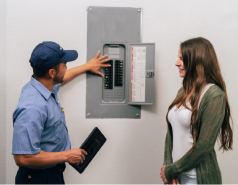
A rewire is also the point where we address the panel itself, and in this part of Cincinnati that often means dealing with equipment that shouldn't still be in service. Split bus panels, which have no single main breaker to shut off the whole system at once, are outdated by current code. Federal Pacific Electric panels with the Stab-Lok label have a well-documented history of breakers that fail to trip during an overload, and Pushmatic panels use a discontinued breaker style that's getting harder to source parts for every year. If your Mt. Healthy home has any of these, we'll walk you through replacing the panel or providing a panel upgrade as part of the rewire, often bumping older 100-amp service up to 200 amps so the new wiring has the capacity a modern household needs.
New Circuits, Redevices, and Grounding
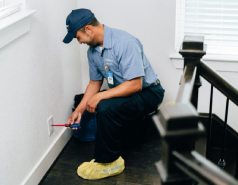
Older homes are also usually short on circuits. If your air fryer trips a breaker every time it runs alongside the microwave, that's not the appliance's fault. It's a circuit built for a 1970s kitchen trying to carry a 2026 kitchen's load. As part of a rewire, we add dedicated circuits where they're needed and redevice outlets, swapping ungrounded two-prong outlets for grounded three-prong ones and installing tamper-resistant outlets in homes with grandkids around. Every circuit gets tied to a properly grounded system, which also clears the way for whole-home surge protection if you want your electronics and appliances covered against the kind of surge damage that doesn't always announce itself the day it happens.
Why Mt. Healthy Homeowners Choose Mr. Electric of Cincinnati Central
Rewiring a house is a big decision, and most people only do it once. We treat it that way. Every job starts with a free home safety check, so you know exactly what we found, what needs to happen, and what it costs before any wire gets pulled.
We serve homeowners across Mt. Healthy and the surrounding west side, including Cheviot, College Hill, North College Hill, Finneytown, Forest Park, Springdale, Northside, Clifton, and neighborhoods closer to Downtown like Over-the-Rhine and Camp Washington. We know which of these areas still have a lot of original 1960s and 70s wiring in the walls, because we've pulled plenty of it out.
We won't leave you guessing about what a rewire costs or how long it'll take. And when we finish, we don't just walk away. We test every circuit, label the panel clearly, and make sure you understand what changed and why.

Let us know how we can help you today.
2701 Spring Grove Ave Ste 205 Cincinnati, OH 45225, United States
Services We Provide
FAQs About Whole House Rewiring: Mt. Healthy
Residential & Commercial Services