Your home electrical system runs through one central point: the electrical panel. When that panel is undersized, outdated, or showing safety risks, every circuit in your home is affected. Flickering lights, circuit breaker trips, buzzing sounds from the breaker box, and burn marks near outlets are not minor inconveniences. They are warning signs that your electrical system needs a Cincinnati electrician. Mr. Electric of Cincinnati Central replaces and upgrades electrical panels, fuse boxes, and breaker panels for homes across Cincinnati and Hamilton County.
Electrical Panel Upgrade in Cincinnati: Licensed, Permitted, Done Right
Electrical Panel Upgrade in Cincinnati: Licensed, Permitted, Done Right
Book Online
Thank you for contacting us!
A representative from our office will get back to you shortly to schedule service.
We're Sorry
Due to a system error, we did not get your request. Please call us for immediate assistance.
We're Sorry
We don't currently provide service to this ZIP/Postal code.
Yes! You can email me service reminders and other messages.
Mr. Electric, a Neighbourly Company on its own behalf and on behalf of and its affiliates and franchisees requests your consent to send promotional and other electronic messages to you concerning products and services they believe are of interest to you. By checking this box, you agree to receive these messages. You can unsubscribe at any time.
Text opt-in does not apply for Canadian residents.
Why You May Need a Panel Upgrade in Cincinnati
Why You May Need a Panel Upgrade in Cincinnati
-
Cincinnati ranks #4 in the country for the oldest housing inventory. Nearly half of all homes here were built before 1960. That means a large share of homes in this city are running on outdated systems, whether a 60-amp fuse box or a 100-amp breaker panel that was never designed for today's electrical load. A modern household running central air, an electric range, a home office, an EV charging station, and smart home technology simultaneously needs 200-amp service. We assess your current system, run a load calculation, give you a clear upfront quote, and get the work done correctly.
-
We handle the permitting process, coordinate the inspection, and back every job with the Neighborly Done Right Promise®. If you are searching for a licensed electrician near you in Cincinnati for a panel upgrade, breaker box replacement, or service change, call Mr. Electric of Cincinnati Central today.

Service You Can Trust!
Let us know how we can help you today.
Why Choose Mr. Electric of Cincinnati Central for Your Panel Upgrade?
You choose us because we treat your home like a licensed professional should: permits pulled, inspections scheduled, work done to the National Electrical Code, and no surprises on the invoice.
- Locally Owned, Nationally Backed: We own and operate this franchise. Behind us is the Neighborly network, the world's largest home services company with more than 5,500 franchises across 30-plus brands and a track record going back to 1994. You get the accountability of a local business and the standards of a national organization.
- Licensed Electricians, Not Handymen: Every technician on our team holds an Ohio electrical license. Panel work involves live service conductors, meter bases, and utility coordination. Ohio Revised Code Chapter 4740 requires that this work be performed by a licensed electrical contractor. We meet that standard on every job. This is not handyman work. It is professional electrical service performed by electricians who follow code, use proper materials, and perform electrical testing before they leave.
- Upfront Pricing, Quoted by the Job: You get a written price before any work begins. No hourly billing that climbs as the job goes on. You approve the number, then we start. Our customer service team is available to answer questions before, during, and after the job.
- We Handle the Permitting Process and Inspections: In Hamilton County, electrical panel work requires a permit and a formal inspection through the Inspection Bureau, Inc. (IBI). We manage the entire permitting process, file the permit, schedule the inspection, and ensure the work meets code requirements before we close the job. IBI handles electrical permits and inspections for Cincinnati and Hamilton County and offers online scheduling seven days a week. You do not have to coordinate any of this yourself.
- The Neighborly Done Right Promise: If the work is not done right, we make it right. That guarantee applies to every job we complete, from a single breaker panel upgrade to a full 200-amp service change.
- Deep Knowledge of Cincinnati's Housing Stock: We work in older homes in Cincinnati every week. We know what a 1940s Clifton bungalow looks like behind the panel door, and we know what a 1970s Monfort Heights ranch needs to support a modern electrical load. We have replaced fuse boxes in Over-the-Rhine, upgraded breaker panels in Hyde Park, and run dedicated circuits for EV charger installations in Mariemont. That field experience shapes how we assess your home.
FAQs About Electrical Panel Upgrades in Cincinnati
-
Your home electrical system gives you signals before it fails. Recognizing those signals early prevents emergency repairs and reduces safety risks to your family.
Flickering Lights
Lights that flicker or dim when a large appliance turns on indicate a power supply problem. The most common cause is a circuit pulling more current than the breaker or wiring is rated to handle. In Cincinnati, homes with older wiring often have flickering lights that point to loose connections at the panel, overloaded breakers, or a failing main circuit breaker. A licensed electrician performs electrical testing to identify the source.
Frequent Circuit Breaker Trips
A circuit breaker trips to protect your wiring from overheating. One trip is a signal. Repeated circuit breaker trips on the same circuit under normal load indicate one of three electrical problems: a circuit overload, a short circuit, or a failing breaker. Circuit overloads occur when the total electrical consumption on a circuit exceeds its rated amperage. Short circuits occur when a hot wire contacts a neutral wire or a ground, causing an immediate surge of current. Either condition requires a professional assessment of your home electrical system.
Burn Marks, Buzzing Sounds, and Burning Smells
Burn marks on outlets, switches, or inside the electrical panel enclosure indicate arcing. Arcing occurs when electricity jumps across a gap in a connection. It generates intense heat and is a direct cause of electrical fires. Buzzing sounds from the breaker box indicate a loose connection or a breaker that is not seating properly. A burning smell near the panel requires a call to an emergency electrician. Do not wait to see if it resolves.
A Panel That Feels Warm to the Touch
Your electrical panel enclosure should not be warm. Heat at the panel surface indicates that current is generating more heat than the system is designed to dissipate. This is a sign of overloaded breakers, undersized wiring, or a failing panel. It is also a direct fire hazard.
Your Home Still Has a Fuse Box
Open your electrical panel enclosure. If you see glass or ceramic fuses that screw in like a light bulb, you have a fuse box, not a circuit breaker panel. Fuse boxes were standard in Cincinnati homes built before 1950. They are limited to 60-amp power capacity in most configurations, have no main circuit breaker, and pose serious safety risks when homeowners install the wrong fuse size. Many Ohio insurance carriers will not insure a home with an active fuse box or charge significantly higher premiums. Replacing the fuse box with a modern breaker panel is one of the most impactful electrical repairs for an older Cincinnati home.
-
The clearest signs are flickering lights when large appliances start, circuit breaker trips under normal load, breakers that will not reset, buzzing sounds from the breaker box, burn marks on outlets or inside the electrical panel enclosure, a burning smell near the panel, or a panel that feels warm to the touch. Any of these individually warrants a professional electrical safety inspection.
If your panel is a Federal Pacific Electric with a Stab-Lok label, a Pushmatic, or a split-bus configuration, replacement is warranted regardless of age. These outdated systems have documented failure rates and are no longer considered safe. According to the Electrical Safety Foundation International, electrical failures and malfunctions cause an estimated 51,000 home fires each year in the United States. In Cincinnati, where nearly half of all homes were built before 1960, outdated panels and fuse boxes are a common finding.
Homeowner Tip: In neighborhoods like Hyde Park, Clifton, and Monfort Heights, Federal Pacific and Pushmatic panels are common in homes built between 1950 and 1985. If you are buying a home in one of these areas, ask the inspector specifically about the panel brand and whether the electrical panel enclosure shows any burn marks or signs of arcing before closing.
-
Open your electrical panel enclosure. If you see glass or ceramic fuses that screw in like a light bulb, you have a fuse box. If you see rows of switches that flip on and off, you have a circuit breaker panel. Fuse boxes are common in Cincinnati homes built before 1950. They are limited to 60-amp power capacity in most configurations, they have no main circuit breaker, and many Ohio insurance carriers will not insure a home with an active fuse box.
Fuse box replacement is one of the most common electrical repairs we perform in older Cincinnati neighborhoods. The upgrade to a modern breaker panel with a main circuit breaker improves safety, increases power capacity, and resolves most insurance issues tied to outdated systems.
Homeowner Tip: If your home was built before 1950 and you have never had the electrical panel replaced, assume you have a fuse box until a licensed electrician confirms otherwise. Many Cincinnati homeowners are surprised to open the panel enclosure and find original fuse equipment still in place.
-
These are two distinct projects. A panel upgrade or breaker box replacement replaces the interior distribution panel, while the service entrance conductors and meter base stay in place. A service upgrade increases the power supply capacity from Duke Energy Ohio into your home. It involves replacing the service entrance cable, the meter base, and the main panel.
A service upgrade requires Duke Energy to disconnect and reconnect your service, adding coordination time and costs. Many Cincinnati homes need both. Others need only the upgrade to the breaker panel. A load calculation per NEC Article 220 determines which applies to your home electrical system.
Expert Insight: Homes built before 1970 in Cincinnati often have original 60-amp or 100-amp service entrance cables. Even if a previous owner replaced the panel, the service entrance conductors and meter base are often still original and undersized. Always have a licensed electrician evaluate both the panel and the service entrance together. We have found 100-amp service entrance wiring behind a newly installed 200-amp breaker panel more than once in Cincinnati homes.
-
Before we recommend a panel size or service upgrade, we perform a load calculation. This is not a guess. It is a structured calculation governed by NEC Article 220 and required by the Inspection Bureau, Inc. as part of the permitting process in Hamilton County.
A load calculation adds up the electrical consumption of every circuit in your home: lighting, appliances, HVAC, water heater, and any planned additions. It accounts for demand factors, which means not all circuits run at full capacity simultaneously. The result is an amp rating that tells us what your home needs from its power supply.
Here is what goes into a residential load calculation:
- General lighting load: 3 volt-amps per square foot of living space.
- Small-appliance circuits: Two 20-amp circuits are required for the kitchen and dining areas.
- Fixed appliances: HVAC, water heater, electric range, dryer, dishwasher, and any other hardwired equipment.
- Demand factors: The NEC allows you to reduce the calculated load for certain appliances because they do not all run simultaneously at full draw.
- Future loads: An EV charging station, a hot tub, a home addition, or a home renovation adds to the calculated load.
A 100-amp panel with a calculated load of 95 amps has almost no headroom. Add an EV charging station drawing 48 amps, and the math does not work. A 200-amp service upgrade solves the problem and leaves room for future circuit expansion.
The IBI provides residential load calculation worksheets for Hamilton County. We complete and submit those worksheets as part of the permitting process. You do not need to understand the math. You need to know that we do it correctly and that the inspection bureau reviews it before approving the work.
-
Working with Mr. Electric of Cincinnati Central is straightforward. Here is the professional panel upgrade process from start to finish.
- You can call or book online. We confirm your appointment and give you a clear arrival window.
- Our electrician arrives on time, in uniform, with a well-stocked service vehicle.
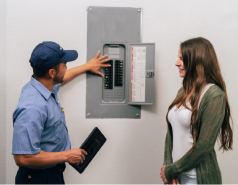
- We assess your current panel, service entrance, electrical layout, and load. We perform a complimentary electrical safety check-up and tell you exactly what we find.
- We complete the load calculation and explain what your home electrical system needs and why.
- You receive a written upfront quote before any work begins. You approve it. We start.
- We manage the permitting process with Hamilton County through the Inspection Bureau, Inc.
- For service upgrades, we coordinate the planned power outage with Duke Energy Ohio.
- We complete the installation, install whole-home surge protection per code compliance requirements, perform electrical testing on every circuit, and document the full electrical layout with labeled breakers.
- We schedule the IBI inspection and make sure the work passes before we close the job.
- We walk you through the completed work before we leave.
Every job is backed by the Neighborly Done Right Promise®. If it is not done right, we make it right.
-
A breaker panel upgrade without a service upgrade typically takes four to eight hours. A full 200-amp service upgrade, including coordination with Duke Energy Ohio and the planned power outage, takes one to two days. The permitting process through the Inspection Bureau, Inc. adds time to the overall project timeline, though the physical installation itself is usually complete in one visit. Electrical testing of all circuits and labeling of the full electrical layout is completed before we leave.
During the planned power outage, your home will be without power. We give you a clear window so you know what to expect and you plan accordingly.
Homeowner Tip: Schedule panel work on a day when you do not need to run major appliances or medical equipment. If anyone in your home depends on electrically powered medical devices, let us know in advance so we can plan accordingly and coordinate the power outage window with Duke Energy Ohio to minimize disruption.
-
Yes. In Cincinnati and Hamilton County, all panel replacements, service upgrades, fuse box replacements, sub panel installations, and new circuit installations require a permit and a formal inspection. The permitting process in Hamilton County runs through the Inspection Bureau, Inc. (IBI), which offers online permit applications and inspection scheduling seven days a week at inspectionbureau.com.
Unpermitted electrical work voids your home insurance, creates problems when you sell the home, and leaves you with work that was never verified for code compliance or safety. Mr. Electric of Cincinnati Central manages the entire permitting process and coordinates all inspections. Ohio adopted the 2023 National Electrical Code effective April 15, 2024. Work done before that date does not meet current electrical codes.
Expert Insight: Some Cincinnati homeowners find unpermitted panel work when they go to sell their home. The buyer's inspector flags it, the sale stalls, and the seller faces the cost of bringing the work up to code compliance and getting it properly inspected. Permitted work from the start protects your investment and your coverage.
-
Yes. NEC 2023 Article 230.67 requires a Type 1 or Type 2 surge protective device on all new and replaced residential service equipment in Ohio. Whole-home surge protection is now a code compliance requirement, not an optional upgrade. When we replace your panel or upgrade your service, a panel-mounted surge protection device is installed as part of the job.
Power surges are a real and documented electrical problem in Hamilton County. Lightning activity during summer storms, Duke Energy switching operations, and large appliances cycling on and off all generate power surges that travel through your circuits. A panel-mounted whole-home surge protection device stops those surges at the point of entry before they reach your electronics and appliances.
Expert Insight: A whole-home surge protection device at the panel does not replace point-of-use surge strips. The two work together. The panel-mounted device handles large external surges. Point-of-use strips handle smaller internal surges generated by appliances in your home. We recommend both layers of protection for any home with sensitive electronics or an EV charging station.
-
It’s like a field experience for us. We open electrical panels in homes in Cincinnati every week. Here is what we regularly see and what it means for your home electrical system.
In homes built before 1950, we frequently find original fuse boxes with 60-amp power capacity and no main circuit breaker. The wiring feeding those fuse boxes is often knob-and-tube, which has no ground wire and was designed for loads a fraction of what a modern home draws. The combination of an undersized fuse box and aging wiring creates compounding safety risks. We address the panel first, then assess the branch circuit wiring separately.
In homes built between 1950 and 1985, the most common electrical problems we find are Federal Pacific Stab-Lok panels, Pushmatic panels, and split-bus configurations. These panels were installed legally at the time. They are now known to have documented failure rates. We regularly see burn marks inside these panels. The burn marks are evidence of arcing that has already occurred. In many cases, the homeowner had no idea.
In homes built between 1985 and 2000, we often find 100-amp panels that are structurally sound but undersized for current electrical consumption. These homes were built before EV charging stations, home offices with multiple high-draw devices, and smart home technology were standard. The panel itself is not failing. The power capacity simply does not match the load. A 200-amp service upgrade with circuit expansion solves this.
In homes undergoing home renovations or home additions, we regularly find that the existing electrical layout has no room for additional circuits. A kitchen remodel adding a dishwasher, a microwave circuit, and under-cabinet lighting requires three to four new circuits. If the panel is full, the renovation stalls. Planning the panel upgrade as part of the home renovation avoids that problem.
Across all of these situations, the most common mistake we see from previous work is unpermitted electrical repairs. A breaker was added without a permit. A sub panel was wired without inspection. The work looks fine from the outside. When we open the panel, we find connections that do not meet code, undersized conductors, and wiring that was never tested. Unpermitted work creates safety risks and creates problems when you sell the home. Permitted work, done by a licensed electrician and inspected by IBI, protects you on both counts.
-
Ohio adopted the 2023 National Electrical Code effective April 15, 2024, for residential properties. Work done before that date does not meet current electrical codes. Here are the key code compliance requirements that affect panel upgrades in Cincinnati.
- Surge protection: NEC 2023 Article 230.67 requires a Type 1 or Type 2 surge protective device on all new and replaced residential service equipment. Whole-home surge protection is now a code requirement, not an optional add-on.
- AFCI protection: NEC 2023 Article 210.12 requires arc-fault circuit interrupter protection on all 120-volt, 15- and 20-amp branch circuits in living areas, bedrooms, kitchens, and dining rooms in new installations and panel replacements.
- GFCI protection: NEC 2023 Article 210.8 expands ground-fault circuit interrupter requirements to include bathrooms, garages, crawl spaces, unfinished basements, kitchens, and all outdoor outlets.
- Load calculation: NEC Article 220 governs the calculation of the required service size. The IBI requires a completed load calculation worksheet for all service upgrades in Hamilton County.
- Labeling: Every circuit in the electrical layout must be accurately labeled at the panel. This is an inspection requirement, not a suggestion.
We follow the 2023 NEC on every job. When we replace your panel or upgrade your service, the work meets current electrical codes, passes IBI inspection, and protects your home insurance coverage.
-
A smart electrical panel replaces traditional breakers with connected circuit breakers that provide circuit-level real-time monitoring of energy consumption, remote control via a smartphone app, and automatic alerts when circuit breakers trip or when power interruptions affect specific circuits. Brands including Leviton, Square D, and Siemens offer smart panel options compatible with modern home electrical systems.
A smart electrical panel is a strong choice if you are adding an EV charging station, building out smart home technology, or want visibility into your electrical consumption by circuit. The smart panel installation happens at the same time as your panel upgrade, so there is no additional disruption.
Homeowner Tip: Smart panels require compatible load centers and smart circuit breakers. Not all smart breakers are interchangeable across brands. We assess your home's electrical layout, confirm compatibility, and install a system with readily available breakers for future circuit expansion. Ask us about smart home services options when you schedule your panel assessment.
-
A breaker panel upgrade without a service upgrade in the Cincinnati area ranges from approximately $850 to $4,000. A full 200-amp service upgrade, including Duke Energy Ohio coordination, meter base replacement, and new service entrance conductors, adds a high cost to the total. Cincinnati homeowners on local forums in 2024 reported quotes ranging from roughly $3,000 to over $7,000 for full service upgrades, depending on panel location, existing wiring condition, and whether AFCI, GFCI, or whole-home surge protection upgrades were included. Permit and inspection fees in Hamilton County are separate. A smart electrical panel installation adds to the total based on the number of smart circuit breakers installed.
Mr. Electric provides a written, itemized quote before any work begins. No hourly surprises.
Homeowner Tip: Get a written, itemized quote. Know exactly what is included before you agree to anything. A quote that does not mention permit fees, Duke Energy coordination, surge protection, or service entrance conductor replacement is likely missing part of the total cost. Ask specifically whether the quote includes the full permitting process and the IBI inspection.
-
No. Ohio Revised Code Chapter 4740 requires that electrical panel work be performed by a licensed electrical contractor. DIY panel work is illegal in Ohio, and inadvisable for reasons beyond the legal. Working on a live electrical panel involves contact with service-entrance conductors that remain energized even when the main circuit breaker is off. Those conductors carry the full utility voltage and are not protected by any breaker in your home. The risk of electrocution is real and serious. Ohio's licensing requirement exists because this work kills people when done by those without the proper training and equipment.
Expert Insight: The service entrance conductors in your panel, the large wires coming in from the top, stay live until Duke Energy Ohio physically disconnects them at the meter. No circuit breaker in your home controls those conductors. A licensed electrician knows this and works accordingly. Emergency repairs on a live panel without utility coordination are among the most dangerous situations in residential electrical work.
-
The right panel depends on your home's electrical consumption, the number of circuits you need, and whether you plan to add future features such as an EV charging station, a home addition, or smart home technology. We install panels from manufacturers with strong reputations for reliable circuit breaker availability, including Square D, Eaton, and Siemens. The most important factors are UL listing, adequate breaker spaces for your current and future circuits, and compatibility with AFCI and GFCI breakers where required by the 2023 NEC.
We size the panel based on your load calculation per NEC Article 220, not on a one-size-fits-all recommendation. A 200-amp, 40-space panel is a common choice for Cincinnati homes with modern electrical demands. If you are considering a smart electrical panel, we factor in smart circuit breaker compatibility at the same time.
Homeowner Tip: Circuit breaker availability matters for long-term ownership. Some older or discontinued panel brands have breakers that are difficult to source, which creates problems when a breaker needs replacement years later. We install panels where circuit breakers are readily available and competitively priced.
-
Yes, and it is important to understand how this works. A panel upgrade replaces the panel, and a service upgrade replaces the service entrance conductors. The branch circuit wiring throughout your home electrical system, the wiring running to your outlets, switches, and fixtures, is a separate system. If your branch circuits are knob-and-tube or aluminum, the breaker panel upgrade does not fix those electrical problems.
Knob-and-tube wiring has no ground wire and was designed for 60-amp service loads. Aluminum branch-circuit wiring expands and contracts with temperature changes, loosening connections over time. Loose connections create resistance, resistance creates heat, and heat damages insulation. According to the U.S. Consumer Product Safety Commission, homes wired with aluminum before 1972 are 55 times more likely to have a connection reach fire hazard conditions than homes wired with copper. Many Ohio insurance carriers will not insure a home with active knob-and-tube wiring or charge significantly higher premiums. A licensed electrician assesses both the panel and the branch circuits and gives you a clear picture of what needs attention and in what order.
Homeowner Tip: Cincinnati ranks #4 in the country for the oldest housing inventory. If your home was built before 1950, there is a real chance that knob-and-tube wiring is still active in some circuits, even if the panel was replaced at some point. Always have the branch circuits assessed alongside the panel. We perform electrical testing on branch circuits as part of our full electrical safety inspection.
-
Yes, and in most cases, a licensed, permitted panel upgrade improves your insurability. Ohio insurance carriers frequently flag Federal Pacific, Pushmatic, split-bus panels, and fuse boxes as uninsurable or charge higher premiums for homes with these outdated systems. After a permitted breaker panel upgrade, your home meets current electrical codes, which most carriers view favorably.
Unpermitted panel work is a different matter. If a claim arises from electrical work done without a permit, your insurer has grounds to deny the claim. According to CincyKY Real Estate, Ohio homeowners’ insurance policies are at risk of being voided or having claims denied when unlicensed or unpermitted work is involved. Permitted work, properly inspected for code compliance, protects your coverage.
Homeowner Tip: After your panel upgrade is complete, notify your insurance carrier. Some carriers in the Cincinnati area will reduce your premium upon documentation that a licensed electrician completed a permitted panel replacement or service upgrade. Provide them with the IBI inspection approval as confirmation.
-
Duke Energy Ohio does not typically charge a standard reconnection fee for planned service upgrades coordinated in advance by a licensed electrical contractor. The utility disconnect-and-reconnect process is part of the normal service upgrade workflow. Timing matters, though. Duke Energy Ohio schedules planned power outages during business hours, Monday through Friday. We coordinate that scheduling as part of your professional panel upgrade process.
Expert Insight: Unplanned power outages or emergency repairs outside normal business hours involve additional fees and longer wait times. Scheduling your service upgrade in advance with a licensed contractor who handles Duke Energy coordination avoids those complications. Emergency electrician calls for panel-related power interruptions cost more and take longer than planned upgrades. Address electrical problems before they become emergencies.
-
Cincinnati homes have specific panel needs driven by their age, their wiring, and the demands of modern life. Here is what we do:
Electrical Panel Replacement and Breaker Box Replacement
If your panel is more than 25 years old, shows signs of corrosion or heat damage, or carries a brand name associated with documented safety failures, replacement is the right move. We remove the old panel or breaker box, install a new UL-listed electrical panel enclosure with properly rated circuit breakers, label every circuit in the electrical layout, and schedule the inspection.
Panels that require immediate replacement include Federal Pacific Electric (FPE) panels with the Stab-Lok label, Pushmatic panels, and split-bus panels. FPE Stab-Lok breakers are prone to failing to trip during an overload. When a circuit breaker fails to trip, current flows through the faulted circuit, generating heat. That heat ignites wire insulation. An independent investigation documented by Cincinnati Insurance Company found that 28% of tested FPE Stab-Lok breakers failed to trip. Experts estimated that those failures contribute to as many as 2,800 residential fires, 13 deaths, and $40 million in property damage annually. Underwriters Laboratories revoked its UL listing for FPE products after the manufacturer obtained approval through deceptive practices.
Pushmatic breakers are prone to sticking in the on position and often lack a main circuit breaker for shutoff. Split-bus panels lack a single main disconnect, creating serious safety risks during an emergency.
These outdated systems are common in Cincinnati homes built between 1950 and 1985. If your home inspector flagged one of these brands, call us before closing.
Fuse Box to Breaker Panel Upgrade
Many Cincinnati homes built before 1950 still have original fuse boxes. These are not the same as a breaker panel. A fuse box uses replaceable fuses instead of resettable circuit breakers. When a fuse blows, the circuit shuts off. The problem is that homeowners often replace a blown fuse with a higher-rated fuse to stop the tripping, thereby removing the protection entirely and allowing the wiring to overheat.
Fuse boxes also lack a main circuit breaker, so there is no single shutoff for the entire panel in an emergency. They are limited to 60-amp power capacity in most configurations, which is inadequate for any modern home. Upgrading from a fuse box to a modern breaker panel with a main circuit breaker is one of the most important electrical repairs for an older Cincinnati home. It improves safety, increases power capacity, and resolves most homeowners' insurance issues tied to outdated systems.
200-Amp Service Upgrade
A service upgrade increases the power supply coming into your home from the utility. Most Cincinnati homes built before 1980 have 100-amp service. That was adequate for the appliance loads of that era. It is not adequate for a home running central air, an electric range, a washer and dryer, a home office, a home charging station for an EV, and smart home technology simultaneously.
A 200-amp service upgrade involves replacing the service entrance conductors, the meter base, and the main panel. The service entrance conductors are the wires running from the utility connection to your meter and panel. This work requires coordination with Duke Energy Ohio to disconnect and reconnect service. We handle that coordination. The work also requires a permit, a planned power outage, and a final inspection before service is restored. A typical 200-amp service upgrade takes one to two days, depending on the scope.
If your existing service entrance cable is undersized for 200-amp service, it needs to be replaced with conductors rated for the new load. For a 200-amp service, that means 3/0 copper or 4/0 aluminum service-entrance cable.
A 200-amp service upgrade also enables circuit expansion throughout your home. Once the power capacity is in place, adding dedicated circuits for a kitchen remodel, a home addition, a workshop, or an EV charging station becomes straightforward.
Breaker Panel Upgrades (Same Amperage, New Panel)
Not every panel job is a service upgrade. If your service entrance and meter base are in good condition, but the panel itself is failing, damaged, or an unsafe brand, we replace the breaker box without changing the service size. This is faster, less intrusive, and does not require coordination with Duke Energy. It still requires a permit and inspection in Hamilton County. This is the right approach when the electrical problems stem from the panel itself rather than from the power supply coming in from the street.
Subpanel and Sub Panel Installation
If you are adding a workshop, a detached garage, a home addition, a finished basement, or an outdoor kitchen, a subpanel feeds power to that space from your main panel. We size the subpanel for the load, run the feeder conductors, and install the subpanel with properly rated breakers. Subpanel work supports circuit expansion without requiring a full service upgrade. It still requires a permit and inspection in Hamilton County.
Whole-Home Surge Protection
Power surges are among the most underestimated safety risks to your home's electrical system. A surge occurs when voltage spikes above the normal 120 or 240 volts on your circuits. The causes range from lightning strikes to Duke Energy switching operations to large appliances cycling on and off. A single power surge lasting milliseconds can destroy electronics, damage appliances, and degrade wiring insulation over time due to repeated power interruptions.
Under NEC 2023 Article 230.67, Ohio now requires a Type 1 or Type 2 surge protective device (SPD) on all new and replaced residential service equipment. That means that when we upgrade your panel, whole-home surge protection is installed to meet code compliance. If you have not had your panel replaced recently, your home likely lacks this protection.
A panel-mounted whole-home surge protection device stops surges at the point of entry before they reach your circuits. It works alongside any surge strips you use on individual devices. The two layers of protection work together. A whole-home SPD handles large external surges. Point-of-use strips handle smaller surges generated by appliances inside the home.
Expert Insight: Duke Energy Ohio territory experiences frequent summer storm activity. Lightning-induced power surges are a documented cause of appliance damage across Hamilton County. A panel-mounted surge protection device rated at 40kA or higher provides meaningful protection against these events. We size and install SPDs based on your home's electrical layout and load profile.
Smart Electrical Panel Installation
A smart electrical panel replaces traditional circuit breakers with connected breakers that give you circuit-level visibility and control. Manufacturers, including Leviton, Square D, and Siemens, now offer smart panel options designed to work with modern home electrical systems.
Here is what a smart electrical panel adds to your home:
- Real-time monitoring of energy consumption by individual circuit, accessible through a smartphone app.
- Remote control of individual circuits, so you shut off a circuit from anywhere.
- Automatic alerts when circuit breaker trips occur, when energy consumption spikes, or when power interruptions affect specific circuits.
- Integration with smart home technology, including EV charging stations, smart lighting, doorbell cameras, and home automation systems.
- Historical energy consumption data that helps you identify which circuits and appliances are driving your electricity costs.
A smart electrical panel is a strong choice for Cincinnati homeowners planning home renovations, adding an EV charging station, or building out a smart home services setup. The panel upgrade and smart panel installation happen simultaneously, so there is no additional disruption to your home.
Homeowner Tip: A smart panel requires a compatible load center and smart circuit breakers. Not all smart breakers are interchangeable across brands. We assess your home's electrical layout, confirm compatibility, and install a system with readily available breakers for future expansion.
EV Charging Station and Home Charging Station Installation
A Level 2 EV charging station requires a dedicated 240-volt, 40- to 50-amp circuit and a compatible electrical panel with available capacity. We assess your current load, determine whether your existing panel supports the addition or whether breaker panel upgrades are needed, and install the EV charger installation with a proper dedicated circuit. We also handle the permit for the circuit installation in Hamilton County.
Many Cincinnati homeowners in older neighborhoods find that adding a home charging station is the right time to upgrade to 200-amp service. The service upgrade addresses the power capacity issue and provides room for future circuit expansion.
Related Electrical Services
A panel upgrade often surfaces other electrical repairs that need attention. We provide a full range of residential electrical services in Cincinnati, including:
- Electrical safety inspection and check-up for the entire home electrical system.
- Ceiling fan installations and lighting fixture installation.
- Smoke detectors installation, testing, and replacement.
- Doorbell camera wiring and installation.
- Dedicated circuit installation for kitchens, home offices, and large appliances.
- Emergency electrician services for urgent electrical problems.
- Outlet repair and replacement, including upgrades to GFCI and AFCI protection.
If our electrician finds additional electrical problems during your panel assessment, we will let you know and provide a clear quote for any additional repairs. No pressure. No surprises.
-
Mr. Electric of Cincinnati Central serves homes throughout Cincinnati and Hamilton County. Our service area covers a wide range of neighborhoods, from pre-war bungalows in Clifton to mid-century ranches in Monfort Heights to larger homes in Indian Hill and Amberley Village.
Communities we serve include: Cincinnati, Wyoming, Over-the-Rhine, Monfort Heights, Finneytown, Forest Park, Mt. Healthy, Springdale, Tri-County area, St. Bernard, Greenhills, Cheviot, North College Hill, College Hill, Northside, Arlington Heights, Clifton, Elmwood Place, Carthage, Downtown, West End, Queensgate, Camp Washington, North Fairmount, Hyde Park, Mount Lookout, Columbia-Tusculum, Oakley, Mariemont, Anderson Township, Amberley Village, and Indian Hill.
We also serve the following Cincinnati ZIP codes:
- 45203: Downtown / West End
- 45214: West End / Queensgate
- 45216: Elmwood Place / Carthage
- 45218: Greenhills
- 45223: Northside
- 45224: College Hill / North College Hill
- 45225: Camp Washington / North Fairmount
- 45231: Mt. Healthy / Forest Park
- 45232: St. Bernard / Spring Grove Village
- 45239: Monfort Heights / Groesbeck
- 45240: Forest Park / Greenhills
Not sure whether we serve your neighborhood? Call us. Chances are, we do.
-
It depends on your current electrical consumption and load. Short circuits and circuit overloads are more common on panels already operating near capacity. A Level 2 home charging station requires a dedicated 240-volt, 40- to 50-amp circuit. If your 100-amp panel is already running central air, an electric range, a washer and dryer, and a home office, adding a 50-amp EV circuit would push it beyond its capacity. A load calculation per NEC Article 220 determines whether your existing service has the capacity for the addition.
Many Cincinnati homeowners in older neighborhoods find that adding an EV charging station is the right time to upgrade to 200-amp service. The service upgrade addresses the power capacity issue and provides room for future circuit expansion. We assess your current load, explain your options, and provide a clear quote before any work begins. EV charger installations require a permit and inspection in Hamilton County.
Homeowner Tip: If you are buying an electric vehicle and your home is more than 30 years old, schedule an electrical safety inspection before your vehicle arrives. Knowing your panel's power capacity in advance lets you plan the EV charger installation without surprises. We assess both the panel and the service entrance during every EV charging station consultation.
-
Older Cincinnati neighborhoods with homes built between the 1920s and 1970s are the most common locations for outdated systems. Hyde Park, Clifton, Mariemont, Mount Lookout, Columbia-Tusculum, Oakley, and Over-the-Rhine have significant concentrations of pre-1960 homes. Neighborhoods like Monfort Heights, College Hill, and North College Hill have large numbers of mid-century homes where Federal Pacific and Pushmatic panels were commonly installed. Many of these homes also have the original fuse box or an early breaker box that has never been replaced.
Higher-value neighborhoods like Indian Hill and Amberley Village also have older homes where original, outdated systems remain in place. Age of the home matters more than the neighborhood's price point when assessing panel risk. A $1.5 million home in Indian Hill, built in 1955, has the same fuse box electrical problems as a $200,000 home in College Hill built in the same era.
Homeowner Tip: If your home was built before 1980, it is worth having a licensed electrician open the panel door and identify the brand, amperage, and condition. That assessment tells you whether your panel is a safety risk, a code compliance issue, or both, before it becomes an emergency repair.
-
Call Mr. Electric of Cincinnati Central! We proudly serve families across Cincinnati and Hamilton County with licensed, permitted, code-compliant panel work. We handle the full permitting process, perform electrical testing on every circuit, and back every job with the Neighborly Done Right Promise®.
Your home electrical system runs through your panel. If yours is outdated, undersized, or poses safety risks, the right move is to have a professional assessment from a licensed electrician who knows Cincinnati homes. We also offer a complimentary electrical home safety check-up. Our electricians assess your panel, outlets, wiring, and grounding system and tell you exactly what they find. No obligation. No pressure.
Call us or book online to schedule your electrical safety inspection or panel upgrade. We are ready when you are.
Residential & Commercial Services






We have the power to make things better.®